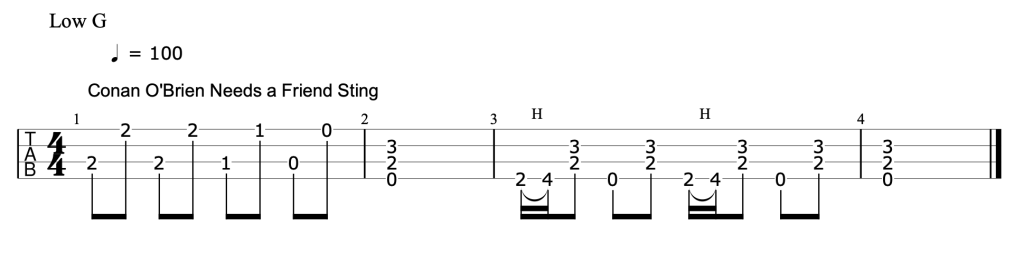
Intro: I did an extended intro based on the verse chords. It’s a little tricky so feel free to adapt it however you like. Or just replace the whole thing with one bar of G like the original.
Verse: First time around, this section is picked (using one finger per string picking). Second time is more loose and strummed with a few notes picked out.
Chorus: The funnest part of the song with a big G chord on the “HEY!”
Solo: Lots of room for your own ideas here too. You could make it as simple as strumming the chords and throwing in a few sus2 and sus4 chords.
Intro: Starting off in usual fashion with Eb leading into G major. The Bb note (A-string, 1st fret) suggests G minor so the G major chord is a little surprising.
Verse: I’m fingerpicking this section the first two times it’s played. The third I’m using some strumming particularly on the Gsus4-G bit. You can do that every time if you prefer.
Chorus: The Eb chord crops up again creating discord under the line, “Everybody’s having fun,” and suggesting the Christmas isn’t as merry as claimed. If that was intentional, Noddy Holder is a more nuanced songwriter than I gave him credit for.
Bridge: I had forgotten this section existed. But it does give us the Gm that has been hinted at since the intro.
Intro and Verse: It starts off straightforwardly in G minor.
Chorus: A switch to G major and a busier melody make for an upbeat chorus. The octaves in 20 and 24 are tricky to play. If you’re struggling, you can play either the top or bottom line alone.
Solo: My version of the solo is only loosely based on the original. There’s plenty of room for making it your own. Bars 37-38 are a pain in the arse to play. But also the best bars in the whole song.
1979 is the Smumpkins’s biggest hit but was almost cut from Mellon Collie and the Infinite Sadness. Which is confusing as that album could do with a dozen songs cutting but not this one.
This arrangement is mercifully easy after the nightmare of Send Me on My Way. This one is all strumming and nothing too difficult with the fretting hand. So you can really concentrate on mixing up the dynamics and enjoying the chill Gmaj7 chords.
Rusted Root’s Send Me on My Way was a bit of a flop when it was first released. But it’s jaunty nature and semi-comprehensible lyrics have given it success in soundtracks to Ice Age, Matilda and that millipede.
There are a lot of rapid notes to get your fingers around in this one. Even at this slightly slowed tempo, it’s tricky to pull off.
Intro: The classic riff. Making use of the high-g string to avoid moving up and down the neck.
Verse: No avoiding moving up and down in this part. But it’s not too difficult until the end of bar 14 with the mabubadeesay mabubadeeum bit (lyric sheets claim he’s saying, “You know what they say about the young,” but there is no way). This includes my favourite trick: playing the same note on different strings (g and E) to allow for quicker picking.
Chorus: Busting out the strums for the chorus. Nothing too difficult here.
Bridge: The trickiest bit with the very quick “Send me on my way”s. I’ve cut down the number of notes in some of these to make them easier to play.
Solo: The funnest bit. As long as you keep the strumming up, you can play around with this section as much as you like.
Outro: Just strumming out the chords in the outro followed by a stripped down version of the riff.
It was a nice surprise to see Paul McCartney playing Oh! Darling live for the first time at the Taylor Hawkins memorial. It’s a nice blend of early-era R&B Beatles in the verses and the harder-edged, bluesier later Beatles in the chorus.
I first heard Joan Jett & the Blackhearts’ Bad Reputation as the Freaks and Geeks theme.It’s a very straightforward punk song that’s ideal for just bashing out.
I’m using strumming the whole way through this. Including using strum blocking to strum the individual notes. You can pick these notes if you prefer, but you lose some of the energy and aggression of the strums.
The intro and verses are very straightforward. It’s one chord all the way through and you don’t have to move up the neck.
But things get much trickier in the transition into the chorus. There’s more movement up and down the neck and some of the twiddles are a challenge. Bar 16 is the section I had to practice the most.
The harmonica solo is very simple. There’s lots of room for being more ambitious here (particularly with the chords just being a C drone) but I like the simplicity of the original.
Following on from These Days with another Cotten-picking arrangement: a rare White Stripes acoustic song We’re Going to Be Friends. But this is easier than These Days as the thumb alternating between the g- and C-strings through the whole song.
The melody is very simple and repetitive almost like a nursery rhyme. But there are slight variations between the verses that you need to include to create at least a little variety.
The only big variation comes in the bridge section where they go far out and include a fourth chord. But you’re still picking the same basic patterns.
For a quick bonus, here’s another ditty Conan uses on his podcast arranged for low-G uke: