Following on from These Days with another Cotten-picking arrangement: a rare White Stripes acoustic song We’re Going to Be Friends. But this is easier than These Days as the thumb alternating between the g- and C-strings through the whole song.
The melody is very simple and repetitive almost like a nursery rhyme. But there are slight variations between the verses that you need to include to create at least a little variety.
The only big variation comes in the bridge section where they go far out and include a fourth chord. But you’re still picking the same basic patterns.
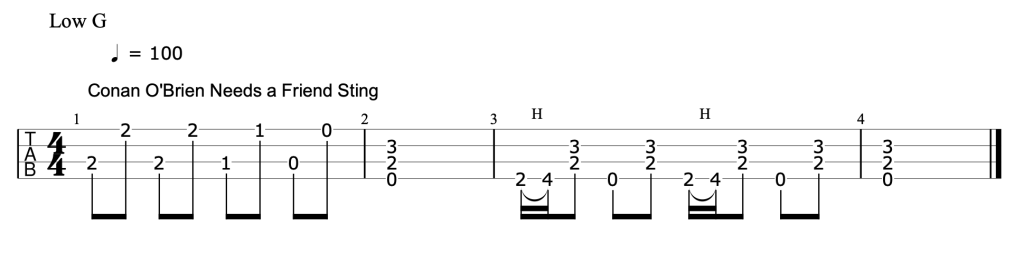
For a quick bonus, here’s another ditty Conan uses on his podcast arranged for low-G uke:
Here’s my attempt at TLC’s heartbreaking tale of Jason Waterfalls.
The intro is by far the trickiest part of the song. There are a bunch of chord stabs and some tasty licks.
The melody line is exceptionally straight-forward and easy to play. The only interesting part is the bluesy “Listen to me” at the end of the verse (bar 28). And I’ve thrown in a couple of licks inspired by the bass in bar 20 and at the end of the choruses.
This arrangement is based on Nico’s version rather the more laid-back Jackson Browne version. I couldn’t resist playing the Cotton picking guitar of the Nico version (played by Browne himself) on the ukulele.
Intro: Setting up the cotton picking pattern along with the thumb alternating between the g- and C-strings, the index finger picking the E-string and the middle A.
Except in bars 1 and 3 you start on the g-string and in the others you’re starting on the C-string. I’ve done to complete the descending line on the g-string. That run goes C-B-A-G in the first bar and needs the F on the C-string to finish it off.
Verse: Some more switching of the pattern in this section. This time it’s because some of the melody notes go low enough to fall on the C-string e.g. the final C note in bar 6 and the C-string, second fret in bar 8.
There’s a break from the alternating picking when you switch to one-finger-per-string picking in bar 12. That continues until you ease back into the alternating style in bar 16.
Solo: My take on the solo is a bit more in the Jackson Browne style. Particularly with the country bend in bar 26. I’ve also taken a hint from the descending bass-line and used a descending line harmonised with thirds in bars 24 and 34. The rest is plucking the chords with a few references to the melody thrown in.
Of course, you’re allowed and encourage to do whatever you fancy in this section and make it your own.
I tabbed R.E.M.’s Losing My Religion a while back. So high time I did a song from their follow-up Automatic for the People.
Intro: Plenty of room to play around with ideas in the intro. I’m just picking out notes from a few chord inversions.
Verse: Just two chords (C and D), a stately pace and a contained melody.
Pre-Chorus: A classic pre-chorus, building up the energy into the chorus. So it starts at the same level as the verse, builds complexity and moves up the neck in bars 26 and 27. Then switches from picking to strumming in bar 28.
Chorus: The trickiest part of the song with chord changes coming thick and fast.
Solo: Another place you can introduce your own ideas. Mine is a similar idea to the intro with notes coming mostly from the chords. I’m also doing plenty of sliding around to emulate the slide guitar in the original.
This arrangement goes straight from the solo in the chorus. So I’ve taken a hint from the pre-chorus and ending the solo with a move up the neck and then some strumming.
Daydream Believer by The Monkees is fairly straightforward to play. The biggest challenges are a few quick hops up the neck. The trickiest one coming in the shift between bars 8 and 9. Other than that, it’s all familiar chord shapes and a simple but insanely catchy melody.
The original is in the key of G and that fits very nicely on the uke so I’ve kept it for this arrangement. The little piano riff in the intro works particularly well.
The song starts off with a bit of dissonance between the Ab on the E-string and the open A string. The Ab also provides dissonance as the first note in the chorus melody (bar 16).
My first arrangement contained strumming almost all the way through. So in the intro I was strumming the second half of bars 1 and 2. And also strumming in the gaps at the end of every other bar in the verse. If you want to do it that way, go for it. But I decided to create a bit more of a contrast been the sections by picking adding picking to the quieter sections.
For the “solo” section of the tab is more in keeping with the spirit of that section rather than the actual notes. It’s really just a breakdown cooling things off before bringing the rock back. So as long as you build up at the end, you’re free to do whatever you like with this section.
I’m still tied to the 90s but for once it’s not a one hit wonder but Nirvana’s Smells Like Teen Spirit.
Teen Spirit has Nirvana’s traditional quiet-loud-quiet-loud dynamics. In this arrangement, the loud bits are done with strumming and the quiet bits are fingerpicked.
I’ve shortened a couple of sections to stop things getting too repetitive. The strumming part of the intro is halved. As is the pre-chorus. If you want to make it even tighter, you could also drop four bars of the chorus.
In case you’re not familiar, the arrows above the notes in bars 5 and 7 are telling you to emphasise those notes. Those are intended to be the “bow-now” notes on the guitar in the quiet bit.
Following on from No Rain with another 90s one-hit wonder: Marcy Playgraound’s Sex and Candy.
The song only has verses and choruses but they still manage to sneak in three key changes. The verses are in G and the choruses in Bb.
The key change from the verse to the chorus is very smooth. Although the Bb note (A-string, 1st fret) isn’t in the key of G, we’ve heard it a lot in the Eb chord and the melody. So the transition that occurs during the “I smell sex and…” part is seamless.
The key change back at the end of the chorus calls attention to itself though. In bar 20 the chords shift down half a step to D to set up the key of G. A bit of theory: the most common way to change key is to play the V chord of the key you’re changing to. This sets up the new key rather than diving straight into it. In this case, D is the V chord of G.
Here’s my take Blind Melon’s massive 90s hit (at least partly thanks Bee Girl).
The arrangement starts off with the iconic guitar riff. It’s a little challenging but sounds great on uke. I recommend learning this bit even if you don’t bother with the rest of the song.
The verse is nice and easy before the chorus moves things back up a notch.
But it’s the solo where things get lemon difficult. So I drop the chords all together for this arrangement. Which does leave things sounding a little sparse. But the solo does a great job of playing with tension so I think it just about works. The repeated pull-offs in bars 33 and 34 build up the tension which gets released with the slides down and up the neck in bar 35. That’s followed by a bluesy section with a rapid descending line finishing it off in bar 38.
No one requested this one. I watched Dr Strangelove last week (for obvious reasons) and was inspired to knock up a quick version of this American Civil War tune from the soundtrack.
I’ve included a couple of fretting suggestions in the tab (the numbers underneath the tab). The trickiest bit is the fast move down the fretboard in bar 13. Originally I was playing all this bar in the fifth position (playing the E-string, 8th fret rather than A-string, 3rd fret). But I found this way made for a much more straightforward change to the F chord in bar 14.