Year: 2017

  • Jonathan Lewis – Raggle Taggle Gypsies (Tab)


    Jonathan Lewis’s campanella ebook is right up there with John King’s as one of my favourite tab books. And he’s just relased a new one 
    Classic Folk Songs for Fingerstyle Ukulele (affiliate link). Which also has traditional tunes but this time arranged in a simpler, more approachable form.

    Jon was kind enough to let me post one of the tabs from his book and I picked Raggle Taggle Gypsies. The tune is a big favourite of mine with my favourite version being Martin Carthy’s. I recorded my own version based on his tab making a few changes to suit my style.

    Links

    More traditional tabs
    Uke Hunt Patreon

  • Muted Strums Tutorial

    Muted strums are a useful tool to have in your repertoire. They can add percussion and syncopation to an otherwise boring strum.

    You perform them by resting a finger or fingers from your fretting hand on the strings. You need to hold them down enough so the strings don’t ring open but not strong enough to hold them down. If you just rest them against the string without applying any pressure it should do the trick.

    There are a few different ways you can perform them:

    – One/Two finger mute: Relax the chord you’re holding, lay pinkie or ringer finger or both across the strings. The advantage of this is that you keep your fretting fingers in the chord position. So it’s useful for mid-strum mutes.

    – All-finger mute: Rest all your fingers across the strings. This produces a very solid mute but does mean your fingers are out of position for chords.

    – Chord release mute: If a chord has you fretting all the strings you can create a mute just by releasing pressure with your fingers just enough to stop the chord sounding. The advantage with this technique is you can very quickly switch between muted and open strums.

    A Chnk Alternative

    The most obvious way to use muted strums is as a substitute for chnks. They provide a similar percussive sound but are easier to pull off.

    Here’s a typical chnk strum played with one finger muted strums. Slowly then up to speed.

    d u x u d u x u

    The main advantage they have over chnks is that they can be played on up-strums as well as down-strums.

    d u x x d u x x

    Nirvana Style Mutes

    Another common place to use them is between chord changes. Most famously used in Smells Like Teen Spirit.

    In this example I’m using all-finger muting.

    d – d – x x x x

    Niles Rogers Style Mutes

    The speed you can apply the chord release muting makes it perfect for funk and disco chord vamps. The great part is that you can just strum down-up-down-up and switch between muted and unmuted strums to create the rhythm.

    In this example I’m playing and muting a G9 chord 4555.

    Picking Hand Muting

    You can also mute the strings at the strumming end of the uke by resting the side of your hand on the strings just in front of the bridge. That dampens the string while still letting you fret the strings and produce a note. You can do this while strumming but it’s even more effective on single notes.

    Here’s a little riff on the C-string just switching between the third and fifth fret. I play this with fingerpicking but this technique works well if you’re using a pick and is easier that way.

    Further Reading

    How to Play Ukulele Strums: my ebook on all things strum related.
    Easy alternatives to chnking
    Strum blocking

  • Beethoven – Ode to Joy (Tab)

    I’ve already tabbed Ode to Joy twice: a dead easy strumming version and the UOGB’s group version. This third and final tab is a fuller solo version.

    For this piece Beethoven nicked Nirvana’s loud-quiet-loud-quiet… trick. So I use strumming for the loud bits and picking for the quiet bits.

    In the open section I strum down for the first note in the bar then flick up with my index finger for the rest. I’ve tabbed all four notes for those flicks but it’s not a big deal whether you hit the top two, three or all four strings. Bars 4 and 8 are slightly different with two down strums and a single picked note.

    I switch to picking for the softer section in bars 9-12 before returning to bombastic strumming. Repeat that section and you’re done.

    If you want more tabs like this you might like my Classical Ukulele ebook with ukulele-style arrangements of classical tunes.

    More classical tabs
    Uke Hunt Patreon

  • Radiohead – No Surprises (Tab)

    I may have to return to OK Computer for another tabbing or two. Every song on the record is incredible. But No Surprises stuck out as the one that’s prime for a ukeing.

    In this arrangement I’ve tried to keep the fingerpicking riff going under the melody. Which works out pretty well for the most part. But you really do have to make sure you emphasise the melody notes or they can very easily get lost in the picking.

    Towards the end I switch towards strumming. To make the melody easy to see I’ve tabbed up the backing strums as just being on the g, C and E strings. But it’s not a big deal if you hit all the strings.

    Links

    Buy it on iTunes
    More Radiohead tabs and chords

  • What it Takes to be a Good Ukulele Group Leader

    A guest post today from Joshua Waldman. As well as leading the Tigard Ukulele Group he has just released a book How to Start and Grow a Ukulele Group (available in digital and paper form (affiliate links)). It’s by far the most comprehensive and inspiring I know of. Highly recommended if you’re starting or running a ukulele group.

    When I started the Tigard Ukulele Group (TUG), I had no interest in leadership. I work for myself in a home office. My business is online and I don’t have a team to manage, nor do I have a boss to worry about. I’m not trying to be a better boss or climb some corporate ladder. What does leadership have to do with me?

    Turns out, I found an answer to that question very quickly! Running an ukulele group has been one of the greatest personal growth journeys I’ve ever undertaken.

    What I learned is that being a leader requires you to find your self-confidence, own the room, make decisions and take risks. It also means potentially making public mistakes and embarrassing yourself. But it also means being someone that others can rely on, being the beacon that guides people, of taking the initiative on fun and inspiring projects.

    You make the call

    When I first started TUG, we went around in a song circle. Everyone brought their own songs and some extra copies to pass around. This worked fine for the first few weeks and when we had around seven people in my living room. However, as we grew, the song circle format fell apart. Songs bombed. We ran out of music to play.
    So the next time we met, I told them what we were playing. “Here’s our song list.” I remember feeling totally surprised that everyone agreed to this. Looking back, this makes sense, they came to play music, not lead a group. That was my job. Even now, at potlucks and parties, when I ask the group what they want to play they look back at me and say, you tell us, we’ll follow.

    A few years ago, we were preparing for our very first concert and used our jam sessions to practice songs on our setlist. Our focus was to get into songs and out of songs at the same time. For weeks, we played the same songs over and over again. The concert happened. It went great! And I kept up the practice of repeating songs that needed more work.

    After a while of this new format, I checked in with the group to see if they were getting tired of this. To my surprise, everyone really appreciated it. This format continued naturally, even after the concert. In fact, to this day, if a song could have gone better, and I’m about to flip to the next one, members will ask to repeat it, “just one more time.”

    You are the leader of your group. You make the calls. Stop looking for approval or consensus. It’s not you imposing your will on others. It’s you offering others the chance to relax and just follow along. Leadership is service to others.

    Own your mistakes

    We were working on a difficult and highly orchestrated song at TUG one time when a longtime member who hadn’t been for a while showed up. She hadn’t been there the previous two weeks while we were working on this. When she raised her hand and offered some suggestions that would have radically changed what we’d been doing for weeks, I shut her down. “It is the way it is. No more changes,” I said and then watched as she shut down, stopped playing and her body folded in on itself.

    I immediately realized my mistake, having gotten so intensely focused on getting the song right that I forgot that we were there to have fun! After the session, I went up to her and apologized. Although she shook it off, said it was no problem and changed the subject, I could tell she appreciated the apology.
    Leadership isn’t always easy. But it does make you a better human being as long as you learn from your mistakes.
    What I learned from leadership

    What I learned is that leadership is a very personal journey. It’s a mirror for your own limiting beliefs, low self-esteem, self-doubt and fears. One of the greatest benefits of having started this group has been the chance to face these parts of myself and deal with them and then grow as a person.

    Leadership is an interesting thing. In an age that seems to value collaboration and groupthink as ultimate ideals, apparent leadership seems to be based on how rich you are or how many likes you get on social media posts. I think this is a sad waste. Everyone has leadership potential. Despite our media, human nature is human nature, and groups of humans seek out a leader to represent them. The world isn’t run on consensus or on who has the most likes.

    Joshua Waldman is the founder of Tigard Ukulele Group and had just published a book called, How to Start an Ukulele Group where you can find more stories and thoughts on ukulele group leadership.
  • alt-J – Fitzpleasure (Tab)

    There’s a new alt-J album out. And very good it is too. To celebrate here’s a tab of my favourite alt-J song Fitzpleasure.

    There’s a lot going on in this song (as with most alt-J songs). At first I thought I’d have to use multiple ukes to do it. But the melody, chords and riffs are all so strong and elegant they ended up working pretty well on just one uke. The only major part I had to cut was in the, “steepled fingers…” section. The descending riff in bars 59 and 60 should carry though there but I had to switch to chords to carry it off.

    I use a capo on the second fret for my version. But that’s only because it makes it in the original key so it was easy for working it out. You can play it without the capo without causing any problems.

    Links

    Buy it on iTunes
    alt-J – Ripe and Ruin (Tab)

  • Old Crow Medicine Show – Wagon Wheel (Tab and Chords)

    What a brilliant song. And one that’s very popular with uke groups. It started life as a half-written Bob Dylan song called Rock Me, Mama before OCMS finished it up and launched their career with it. It’s been covered many times since with Darius Rucker‘s being the most popular.

    Like the original, I’m using a capo on the second fret. It’s not essential but it does make the chords much easier and avoids the dreaded E chord.

    Suggested Strumming

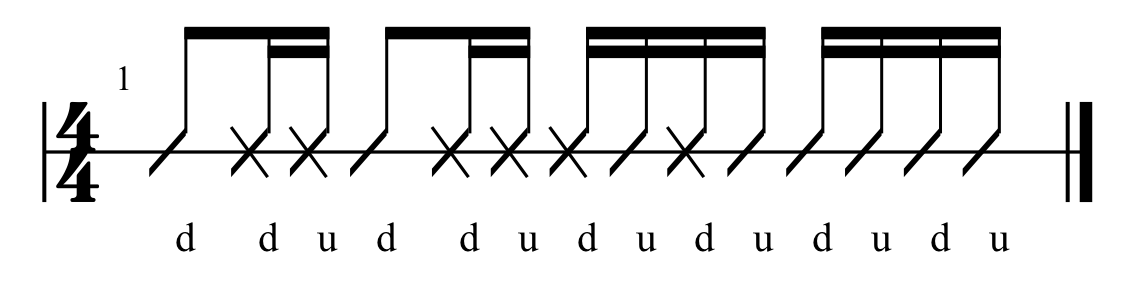
    You can use this simple pattern all the way through:

    d – d – d u d u

    Use that once for every chord until the last C in the progression where you play it twice.

    Here’s how it sounds:

    Twiddley Bits

    Here’s an arrangement of the violin part in the intro (which starts four bars into the song). Again, there’s a capo on the second fret.

    The example finishes up with the violin lick in the outro.

    Links

    More 90s tabs
    Uke Hunt Patreon

  • Nancy Sinatra – Bang Bang (Tab)

    It wasn’t until embarrassingly recently that I found out Bang Bang was written by Sonny Bono and first recorded by Cher. But it’s the sparse and haunting Nancy Sinatra version that is the most famous. But I don’t think any cover has eclipsed the original since Oasis’s version of Mike Flowers Pops’ Wonderwall

    For my version, I’ve taken cues heavily from the Sinatra version. Keeping the timing and the phrasing very loose.

    In the tab there are a few repeat symbols you’re unfamiliar with. The first repeat comes at the end of bar 16 with the familiar double bar and dots. That sends you back to bar 5. From there you play through to bar 20 where it says D.S. al Fine (Da Segno al Fine). That sends you back to the squiggle at bar 5 and tells you to stop where it says Fine in bar 16.

    Links

    Buy it on iTunes

    More 90s tabs
    Uke Hunt Patreon

  • alt-J – Interlude I (Ripe and Ruin) (Tab)

    alt-J’s new track 3WW has me very excited for the new album. In preparation I thought I’d have a go at Ripe & Ruin from their debut album.

    Ripe & Ruin is an acappella duet (the good kind of acappella where everyone sings words and no one is doing cheesy beatboxing). But I’ve taken some liberties with the arrangement having anything between one and three notes at a time.

    The only tricky part of the arrangement is the rapid jump up the neck in bar 24. Otherwise it’s pretty straightforward so you can concentrate on varying the dynamics.

    Links

    Buy it on iTunes

    More alt-J tabs
    Uke Hunt Patreon

  • Beach Boys – Sloop John B (Tab)

    Following on from Good Vibrations, another Pet Sound with bass from Lyle Ritz. Sloop John B is a traditional Bahamian song. The earliest version was recorded in Nassau in 1935 under the title Histe Up the John B Sails. There are many lyrical variations. My favourite being the the verse in Blind Blake’s version (the Bahamian one rather than the American blues guy) about having to go home because his pants burst.

    This arrangement starts off with that shimmering guitar riff from the Beach Boy’s version. And I keep interlacing this riff with the melody throughout. Be sure to play this softer than the melody so the two don’t get confused.

    The verse is all fingerpicked with the melody mostly on the E- and A-strings with some lower notes on the C-string to keep the rhythm going. To give the chorus a bump I play the melody with strums. That means you have to switch between strumming and picking. Which can be tricky. If you need a bit more time to switch you can miss out a note or two of the backing without losing anything important.

    Links

    Buy the Beach Boys version
    More Beach Boys tabs