If you’ve been following my riffs for ukulele series, you’ll have heard me encourage you to use it more creatively than just playing one riff at a time. One way to use them is to cram a bunch of them together to make a melody. That’s what I did with my Arctic Monkeys medley and this collection of Strokes riffs.
The songs in this medley are:
Barely Legal/Take It Or Leave It/Hard to Explain/12:51/One Way Trigger/Reptilia/Barely Legal (again)/Someday/Under Cover of Darkness/Last Nite
I had assumed Junior Brown’s Better Call Saul would be the theme tune to the show. But they went with the more unexpected choice of, Nottingham indie rockers, Little Barrie.
But the theme is very in keeping with the feel of the Breaking Bad theme. It’s similarly sparse which makes it a bit tricky to keep time. As you can see in the video, I keep strumming without touching the strings to keep time. But you can do it by tapping your foot or nodding your head.
After last week’s two nightmaredifficulty posts something much more straight forward this week.
Like the original, I start my version off with just the melody. It’s a great traditionally inspired melody (written by the guys off of The Lumineers) and is plenty strong enough to hold your attention alone. I’m just picking this with my thumb but you can use fingers if you’re comfortable with that.
Then from bar 17 I introduce a few chords but still keep it very minimal. Again, I’m just using my thumb to play these. Strumming down the strings whenever there’s more than one note.
Here’s one if you’re looking for a challenge. There are lots of jumps around the neck, syncopated rhythms, twists and turns, and tricky strum blocking to get to grips with.
On part that isn’t too difficult is the strumming hand. Most of the song my right hand is just strumming sixteenth notes. The rhythm is created by muting and playing strings with the left hand.
For example, in the intro you play a constant strum, hold down the chord stabs and mute the g-string (I use the thumb of my fretting hand), otherwise mute all the strings.
The verse is done in a similar way. Strum constant sixteenth notes and mute the strings when nothing is played. The difference is you also have to mute all but one string. That can get tricky and it takes a lot of practice. I call this strum blocking and I did a tutorial on it here. It’s a great way to give a piece lots of attack and a strong rhythm.
In this song I mostly mute the g-string with my thumb, C-string with my middle finger, E-string with my ring finger and the A-string with the underside of my index finger. But you’ll need to play around with it and see what works best for you.
I had to do this tab to celebrate the finale of the first series of Serial. The plinkiness of it was just dying to be uked. To keep it extra-plinky it’s played right up the neck.
I don’t know how many times I’ve heard this tune. Several hundred I expect. But not once did it occur to me that there might be a reason he’s going on about tossed salads and scrambled eggs. Frasier writer, Ken Levine asked the tune’s composer Bruce Miller who explained, “these were things that were “mixed up” like Frasier Crane’s patients”.
And it’s not just the patients. The theme is a mixed up, mouse painting, moon howling kinda song. For a tune that only lasts 36 seconds this really packs in a lot of different notes. My advice is to throw yourself into it an not worry much about any mistakes.
The Little Drummer Boy is (supposed to be) based on an old Czech folk melody. But it only became well known when rearranged and given lyrics in the 1950s for the Harry Simeone Chorale version.
This arrangement is designed to be played solo. It can all be played with your thumb on your picking hand. When you play more than one string just strum your thumb down until you hit the last note in the chord.
The notes in brackets here are backing notes. They’re not part of the melody so play them softly.
Have to admit, I’ve never actually seen Unforgiven. It’s a western with Clint Eastwood and that’s about all I know. But I got a request for Claudia’s Theme, gave it a listen and loved it. Plus it seems ideal for the uke.
The original starts in the key of E before switching to F. But I stuck to the more uke-friendly F for my arrangement.
The intro and outro are very sparse. If you catch me nodding my head in those sections that’s me trying to keep time. It’s very tempting to rush these bits. But I’d recommend trying as hard as you can to hold it back.
Way back in 2007 the second ever chord post I did was Despair in the Departure Lounge. Since then there’s been a steady stream of request for more Monkeys which I’d always replied to with, “I’ll do another Monkeys tab when they go back to making good records.” Johnny called me out on that promise correctly pointing out that the new album is awesome.
So here’s a medley of most of the songs on the album:
One for the Road/Do I Wanna Know?/Why’d You Only Call Me When You’re High?/Arabella/Knee Socks/I Want It All/R U Mine?
Trickiest Bits
The trickiest bits for the fretting are the two big leaps on the fretboard. There’s the big slide up in R U Mine? where it isn’t such a big deal if you don’t hit it exactly. The really hard one is the 8th fret in bar 5. Cut that 1st fret note before it really short to give yourself some time to get up.
The trickiest bits for the strumming hand are the palm muting (i.e. lightly resting the underside of your hand on the string at the bridge to muffle the strings). In One for the Road and Why’d You Only Call Me When You’re High? I’m muting all the strings. In Do I Wanna Know? I’m trying my best to mute the C-string while letting the E- and A-strings ring. As you can hear in the video I don’t always pull it off. It’s hard to get right so there’s nothing wrong with playing this section without any muting at all.
With all the intricate and dexterous actions that evolution has equipped our hands for it’s left us woefully unprepared to play an Fmaj7 chord on the ukulele. It’s made plenty of chord changes a pain in the arse too.
Laziness to the rescue! You can change the fingering of a chord or use a different inversion to make changes much more straightforward.
Here are a few tricky chord changes that can be simplified with a bit of rejiggering.
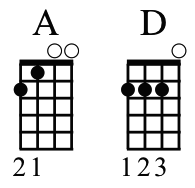
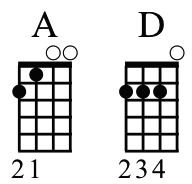
A to D
Here’s an obvious refingering. If you use your second, third and fourth fingers to play it you can keep your first finger tucked behind.
The Sucker Way
The Smart Way
Video Comparison
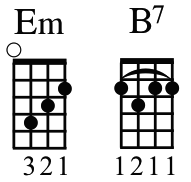
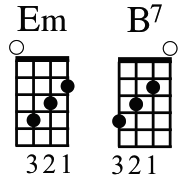
Em to B7
In chord charts the B7 is almost always shown played with a barre. But it doesn’t have to be. Switch the notes on the g and A strings and you get the Em chord shape with everything moved across one string.
The Sucker Way
The Smart Way
Video Comparison
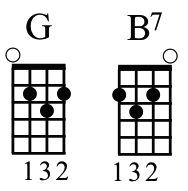
G to B7
Another B7. This one doesn’t actually have a B in it. But thanks to crazy ear-shenanigans your brain fills in the B for you (here’s Vi Hart explaining it as well as why chords and scales are as they are).
The Sucker Way
The Smart Way
Video Comparison
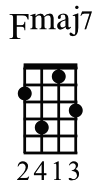
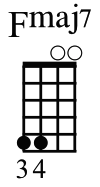
Anything to Fmaj7
If anyone tells you to play Fmaj7 the 2413 way throw your ukulele at them and run away. They are not your friend. In the first take of my trying to play the chord you can actually hear my wrist cracking as I attempt it.
The Sucker Way
The Smart Way
Video Comparison
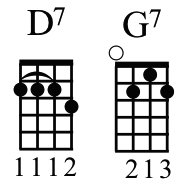
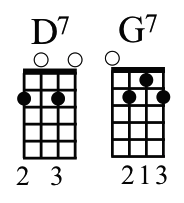
D7 to G7
Like the B7, this version of D7 doesn’t actually have a D. But it is way easier to play. This version is often called the ‘Hawaiian D7′ for reasons that elude me.