I’ve kept the arrangement very simple. There are just three underlying chords: F, Bb and C. And I’m only using my thumb for picking. Although you could very easily use fingerpicking or a pick. Using those might help with the quick thumb work in bars 5 and 6.
There’s a long history of murder ballads in folk music. But they’re all set comfortably in the past. It’s a very different experience listening to a song about murders set in your own lifetime.
The Shankill Butchers were loyalist gang in 1970s Northern Ireland who viciously murdered 19 people (possibly with police turning a blind eye). Hearing a song mythologising them is an uncomfortable experience. But it brings home how fresh the events in old murder ballads were to those who originated them.
Shankill Butchers is in the key of C#m. My first instinct was to rearrange it into a more uke-friendly key like Cm or Dm. But it turned out to work best in C#m. The intro riff (played with the thumb alternating between picking the g- and C-strings) works particularly well.
One of the many areas the BBC excels in is the exceptionally nerdy quiz show. I can’t imagine anyone else coming up with museum based quiz or a show like Only Connect where questions are chosen via Egyptian hieroglyphs.
Connecting Only Connect to ukuleles is very easy. Season three winner Jenny Ryan (who went on to become The Vixen on The Chase) is a keen uker with the excellently named Nanukes of the North.
I first tabbed up this tune 11 years ago (almost to the day) but never got around to doing a video of it. But having finally got around to watching the final season (I dropped out because season 8 was so awful) I finally got around to making one.
I made some minor changes so I’ve redone the tab.
Dunder Mifflin Jingle (People Person’s Paper People)(Tab)
While I was at it, I also felt the need to tab the Dunder Mifflin jingle from the Local Ad episode. I’ve tabbed the first version from the episode. Which was written by, BoJack Horseman composer and brother of BJ, Jesse Novak.
I considered posting this song back when Amy Winehouse died but it seemed like exceptionally bad taste at the time. But it’s far too great a song to ignore for long and I’m not going to hold her questionable uke skills against her.
To keep the tab a manageable length I’ve notated straight repeats for the second verse. But there are a couple of differences between the verses. So I’ve added those at the end of the tab.
I’m using my thumb, index finger and middle finger for all the picking. But I’m am switching which strings those cover. As a general rule, if there’s no g-string in the bar my thumb is on C, index on E and middle on A. If there is some g-string, my thumb will be on g, index on C and middle on E.
The chord that really makes this progression is the F# (the major III chord in theory terms). In the key of D you’d expect to hear and F#m (which also crops up the progression). The Bb note in the F# chord doesn’t fit in the D major key so in creates loads of tension until it becomes more settled in the G chord. It’s a classic chord trick. You can hear the same move (I – III – IV) in the chorus of Tennesee Waltz.
Mardy Strum
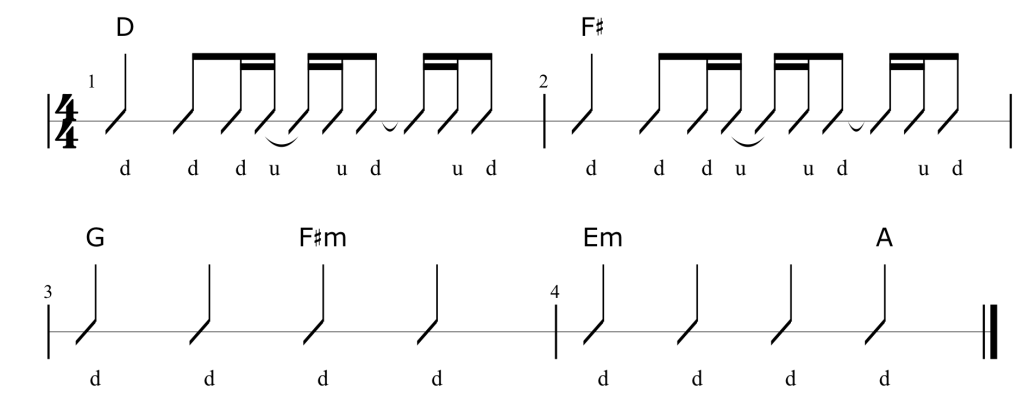
Intro, Verses, Break and Solo: The intro starts with all down strums (eight per chord). Then I switch to this pattern (which you can hear in the video below):
The xs indicated strums muted with the fretting hand. If you want a simpler strum that doesn’t use muting here’s one that takes the rhythm from the intro solo:
Which sounds like this:
Chorus: The chorus is much more straightforward. It’s all down-strums. One each on all the Gs and As. Two on the D. And three on the Bm. The exception is the last chorus where it’s just one down-strum per chord (and don’t forget the lenthened Bm chord).
Middle: Eight fast down-strums per chord. Until the final F#-G-A move where you do two slower down-strums per chord.
Twiddly Bits
Two little twiddles from the song. Both use the D major pentatonic include C# from the standard major scale.
What a brilliant song. And one that’s very popular with uke groups. It started life as a half-written Bob Dylan song called Rock Me, Mama before OCMS finished it up and launched their career with it. It’s been covered many times since with Darius Rucker‘s being the most popular.
Like the original, I’m using a capo on the second fret. It’s not essential but it does make the chords much easier and avoids the dreaded E chord.
Suggested Strumming
You can use this simple pattern all the way through:
d – d – d u d u
Use that once for every chord until the last C in the progression where you play it twice.
What a great melody this is. And it’s matched with some juicy jazz chords. Making it perfect for a ukeing.
In case you’re not familiar with the repeat markings I use, you play up to “D.S. al Coda” go back to the squiggle in bar five, play up to “Da Coda” then skip to the target in bar 23.
This arrangement is in five parts. All very simple. And all but Uke 3 are played with a pick. Although all could be managed perfectly well with fingers.
Uke 1
Uke 1 is just a two note stab played the whole way through.
Uke 2
Uke 2 acts as the bass so it’s played on a low-G ukulele. (All the others are in standard tuning.) The part is just eighth notes on the open G-string all the way through.
Uke 3
Uke 3 is the one fingerpicking part. Alternating between the g- and A-strings means you can let the notes ring into each other.
It kicks off in bar 5.
Uke 4
Uke 4 comes in at bar 9 and is what I think of as the, “It’s time for baking,” line.
Happy St Patrick’s Day! To celebrate I arranged my favourite song by my second favourite Irish songwriter (can’t can The Van).
One of the things I love about arranging tunes is noticing little things that completely passed me by listening casually. I didn’t realise that the melody in the chorus shifts against the chords. The basic chords though the whole song are Am-F-C-G. The first, “Is that alright?” is on the Am and later it’s on the F chord. Of course, I completely ruin it by arranging them both exactly the same way.