In that spirit, I’ve kept the arrangement as simple as I could. The verses and bridge are played with one finger per string picking building up to strumming in the chorus and middle sections.
There’s loads of room to add your own spin onto this song. You can play around with dynamics and pacing, change the phrasing, throw in chord extensions or add in a few jazzy runs. Check out Louis Armstrong’s version for inspiration.
It seems like every cover version ditches the intro section of the original. And I’ve done likewise. I’ve replaced it with a chord section that establishes the harmony of the tune by borrowing chords from elsewhere in the song. This is a good place to start adding your own ideas.
A quick bonus tab. In tribute to Roger Bannister I knocked together a simple version of the Chariots of Fire theme tune. There were a bunch of requests for a tab so here it is.
There’s nothing massively challenging in this arrangement but there are a few leaps up and down the fretboard. You can make things a easier with a bit of planning though. In bars 10 and 12 moving your hand up so you play the 3rd fret with your index finger makes it a much easier transition into the next bar.
The chord that really makes this progression is the F# (the major III chord in theory terms). In the key of D you’d expect to hear and F#m (which also crops up the progression). The Bb note in the F# chord doesn’t fit in the D major key so in creates loads of tension until it becomes more settled in the G chord. It’s a classic chord trick. You can hear the same move (I – III – IV) in the chorus of Tennesee Waltz.
Mardy Strum
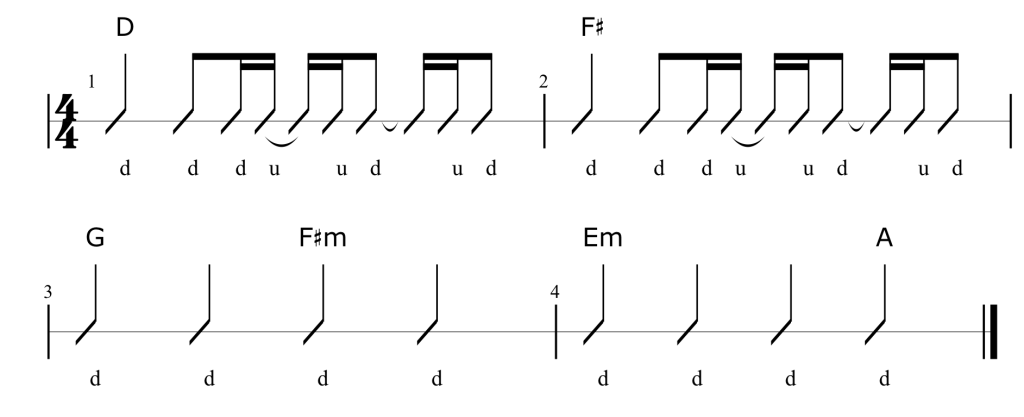
Intro, Verses, Break and Solo: The intro starts with all down strums (eight per chord). Then I switch to this pattern (which you can hear in the video below):
The xs indicated strums muted with the fretting hand. If you want a simpler strum that doesn’t use muting here’s one that takes the rhythm from the intro solo:
Which sounds like this:
Chorus: The chorus is much more straightforward. It’s all down-strums. One each on all the Gs and As. Two on the D. And three on the Bm. The exception is the last chorus where it’s just one down-strum per chord (and don’t forget the lenthened Bm chord).
Middle: Eight fast down-strums per chord. Until the final F#-G-A move where you do two slower down-strums per chord.
Twiddly Bits
Two little twiddles from the song. Both use the D major pentatonic include C# from the standard major scale.
I had to make a change to the scheduled chord post to pay tribute to the incredible soul singer Charles Bradley who died last week. Bradley spent most of his life in complete obscurity as the singer in a James Brown tribute act until the incomparable Daptone Records picked him up and released his debut album in 2011 at the age of 62. The album contained some of the most powerful and heartfelt soul music of the decade and made him an almost instant soul legend.
But most pertinent here is the ukulele track Dusty Blue from his second album with the Menahan Street Band (a track that later popped up on Suits). It’s one of the few ukulele-led soul tracks out there. If you watch careful you can see the studio ukulele in the Charles Bradley documentary Soul of America.
I recorded a version of Dusty Blue a few years ago but never got around to posting the tab. So here, at last, it is.
For this piece Beethoven nicked Nirvana’s loud-quiet-loud-quiet… trick. So I use strumming for the loud bits and picking for the quiet bits.
In the open section I strum down for the first note in the bar then flick up with my index finger for the rest. I’ve tabbed all four notes for those flicks but it’s not a big deal whether you hit the top two, three or all four strings. Bars 4 and 8 are slightly different with two down strums and a single picked note.
I switch to picking for the softer section in bars 9-12 before returning to bombastic strumming. Repeat that section and you’re done.
If you want more tabs like this you might like my Classical Ukulele ebook with ukulele-style arrangements of classical tunes.
I may have to return to OK Computer for another tabbing or two. Every song on the record is incredible. But No Surprises stuck out as the one that’s prime for a ukeing.
In this arrangement I’ve tried to keep the fingerpicking riff going under the melody. Which works out pretty well for the most part. But you really do have to make sure you emphasise the melody notes or they can very easily get lost in the picking.
Towards the end I switch towards strumming. To make the melody easy to see I’ve tabbed up the backing strums as just being on the g, C and E strings. But it’s not a big deal if you hit all the strings.
What a brilliant song. And one that’s very popular with uke groups. It started life as a half-written Bob Dylan song called Rock Me, Mama before OCMS finished it up and launched their career with it. It’s been covered many times since with Darius Rucker‘s being the most popular.
Like the original, I’m using a capo on the second fret. It’s not essential but it does make the chords much easier and avoids the dreaded E chord.
Suggested Strumming
You can use this simple pattern all the way through:
d – d – d u d u
Use that once for every chord until the last C in the progression where you play it twice.
alt-J’s new track 3WW has me very excited for the new album. In preparation I thought I’d have a go at Ripe & Ruin from their debut album.
Ripe & Ruin is an acappella duet (the good kind of acappella where everyone sings words and no one is doing cheesy beatboxing). But I’ve taken some liberties with the arrangement having anything between one and three notes at a time.
The only tricky part of the arrangement is the rapid jump up the neck in bar 24. Otherwise it’s pretty straightforward so you can concentrate on varying the dynamics.