Death with Dignity is a beautiful song by Sufjan Stevens about the death of his mother (a subject that clearly resonates with Kanye West). The song is heavy with grief backed with sparse, shimmering ukulele. And idiots will still tell you it’s impossible to be sad when playing a ukulele.
I think he’s using open C-tuning for this which is gCEG (i.e. tune your A-string down so it’s the same pitch as the g-string). Then capo at the fourth fret.
This part is really quiet on the record so I’m making it up about half the time. Take that as a free pass to mess around with this part and play it how you feel it. I’m guessing it’s played on a classical guitar but it works perfectly well on baritone.
Cartoon Network’s Over the Garden Wall has featured a bunch of old-timey musicians including Frank Fairfield, Jerron “Blind Boy” Paxton and ukulele chanteuse Janet Klein. I got had a request I couldn’t ignore for a song from the show so it was inevitable I went for Klein’s Langtree’s Lament.
Nothing too tricky in this arrangement. It’s almost all played with strums. There are some places when you’re not strumming all the strings e.g. bar 10. There the melody switches to the g-string so you need to emphasise that string. It’s not a big deal if you don’t hit exactly the strings tabbed so long as you’re holding the chord down (in that bar Bb7).
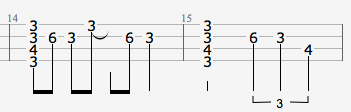
The notes I pick are the slides up to the fifth fret in bars 2 and 6, the one note in bar 7 and the campanella picking in bars 14 and 15. If you’re dead set against campanella you can also play it like this:
I’ve tackled Ray Parker Jr’s Ghostbusters theme once before way back in 2007. But I wanted to return to it to tidy it up and make it into a full instrumental version for a ukulele group. Also because it’s a stone-cold classic.
This version has five different ukulele parts of differing levels of difficulty (including one that just involves smashing the strings in time) and each one can be simplified or fancied up as suits.
This part takes care of all the chord work. For almost all the song the chords are just C – Bb – F. You can choose whichever inversion of those chords suits your playing.
This part plays the riff for most of the song. For the intro and middle sections I make use of campanella style. Letting close harmony notes ring into each other makes them extra spooky.
My original plan was to combine this part and the melody part. In the end I split them off so I could have the vocal part more prominent than this one. But the two parts are never playing at the same time so you can easily combine the two into one part if you wish.
The part starts of by plucking the strings with a pick between the nut and the pegs. It’s always high-pitched and out of tune up there so you’ll always get a spooky effect from it.
The intro spooky noises do include one additional uke. I scrapped a pick along a wound low-G string to get a bit of a creaking effect.
Percussive Uke
No notes at all in this part. I’m just muting all the strings with my fretting hand. I’m using two main patterns. The first one in the video I strum down right in front of the bridge to create a thud. Then up again in that area. Then and other down-up where the fretboard hits the body.
The next pattern is the same sort of idea. Start with the same down-up near the bridge. Then three down-ups at the fretboard.
The bridge strums do give you a good sound but they’re a bit tough on the fingers and not essential. You can also emphasise beats just be strumming more forcefully.
The Quizeum is BBC4’s traveling museum panel show and my new favourite quiz. How could you not love a high-brow quiz show not afraid to use the phrase, “You’ve got a face full of dicks”?
It also has a pleasant, bouncy theme tune that works well on uke.
The Brain Scoop is one of my favourite YouTube channels. It’s the channel of Emily Graslie who was working in a tiny museum in Missoula when Vlogbrother Hank Green featured her in a video and talked her into starting a YouTube channel. Now she works in the massive Field Museum making videos on everything they do from slicing open animals, to expiditions, to searching through their collections (including their ukulele). I highly recommend checking it out.
It also has a catchy theme tune (by general Nerdfighteria producer Michael Aranda) that I had to do a uke version of. I’m very excited that it got the Brain Scoop and Hank Green seal of approval.
I had assumed Junior Brown’s Better Call Saul would be the theme tune to the show. But they went with the more unexpected choice of, Nottingham indie rockers, Little Barrie.
But the theme is very in keeping with the feel of the Breaking Bad theme. It’s similarly sparse which makes it a bit tricky to keep time. As you can see in the video, I keep strumming without touching the strings to keep time. But you can do it by tapping your foot or nodding your head.
I had to do this tab to celebrate the finale of the first series of Serial. The plinkiness of it was just dying to be uked. To keep it extra-plinky it’s played right up the neck.
Have to admit, I’ve never actually seen Unforgiven. It’s a western with Clint Eastwood and that’s about all I know. But I got a request for Claudia’s Theme, gave it a listen and loved it. Plus it seems ideal for the uke.
The original starts in the key of E before switching to F. But I stuck to the more uke-friendly F for my arrangement.
The intro and outro are very sparse. If you catch me nodding my head in those sections that’s me trying to keep time. It’s very tempting to rush these bits. But I’d recommend trying as hard as you can to hold it back.
I was inspired by Action Bronson’s Contemporary Man from his latest mixtape to create a 80s medley of my own. And it’s a good opportunity to show how I intended the riffs posts to be used. And it means there’s plenty of scope to add your favourites to the medley.
The first four songs are the same as Contemporary Man: Peter Gabriel’s Sledgehammer, Phil Collins’ Sussudio, John Mellencamp’s Jack and Diane, Phil again with Another Day in Paradise. Then a couple of my favourites I’ve done before in the riffs series: Harold Faltermeyer’s Axel F and Jump by Van Halen.
Anyway, their performance inspired me to have a go at this instrumental piece. I first tried it on standard uke but it didn’t work out. I moved on to low-G with was better. Then I went insane and decided to drag my aNueNue harp ukulele out of deep storage.
Harp Ukulele
The harp strings on the uke are supposed to be tuned C, D, E, F. But I retuned the bottom two to A. One to pluck and the other to give a bit of sympathetic resonance. The sympathetic resonance turned out quite well. You can particularly hear the reverb-like effect at the beginning.
Important: The letters above the tab represent the bass note being played in that bar they’re not the chords.
Low-G
The strings tabbed are just tuned like a normal low-G. And it’s tabbed in the same key as the original. So if you’re playing a low-G you can just play this tab along with the record or a bass-playing friend.
Standard Tuning Version
To play it with a high-g ukulele you’ll need to move the whole thing up an octave. Here’s a tab for that. This time with the chord names above the tab.