Technically, I shouldn’t be posting this on White Album week. But it was recorded during the White Album sessions and it is one of the best (possibly the best) Beatles song. If you’re dying for a White Album song have a go at the Blackbird tab.
I’ve kept the arrangement as simple as possible. It has such a strong (and well known) melody it doesn’t need much to back it up. I’m not following any strict pattern for the fingerpicking. For the most part the thumb plays the lowest string in the bar then letting the fingers fall on a string each from there.
In the repeat of the chorus I play a slight variation on the, “And don’t you knowwwwww…” in bars 15 and 16.
After all that I switch to strumming and the occasional finger flick for the boisterous sh-outro. I bash out a couple of adornments in this section. You don’t need to do anything complicated with these so long as you use the appropriate amount of gusto. Both mine are just based on the C7 chord.
I considered posting this song back when Amy Winehouse died but it seemed like exceptionally bad taste at the time. But it’s far too great a song to ignore for long and I’m not going to hold her questionable uke skills against her.
To keep the tab a manageable length I’ve notated straight repeats for the second verse. But there are a couple of differences between the verses. So I’ve added those at the end of the tab.
I’m using my thumb, index finger and middle finger for all the picking. But I’m am switching which strings those cover. As a general rule, if there’s no g-string in the bar my thumb is on C, index on E and middle on A. If there is some g-string, my thumb will be on g, index on C and middle on E.
I don’t cover a lot of pop music on here but Charli XCX’s contribution to the long tradition of lusty songs about handsome boys was the song of last summer and one of my favourite songs of the year.
The arrangement is a bit tricky with a few leaps up and down the fretboard. Probably the trickiest parts are the Mario coin noises. These are created by playing a note on the E-string 10th fret quickly followed by natural harmonic on the A-string, 12th fret. If you’re still getting the hang of natural harmonics you can fret the string at the 12th fret as you usually would. It won’t have the same ringing sound but it will sound right.
I first tried to do a uke arrangement of The Woodpile back when it came out in 2013. But it quickly joined the massive pile of tabs I’ve started but wasn’t satisfied with. But with the death of Scott Hutchison I had to dig it out and get it finished. Particularly since Midnight Organ Fight is up there with Pet Sounds as one of the great albums that has a tiny bit of ukulele on (in the later part of Good Arms vs Bad Arms).
There are a couple of things that make this tune tricky. First is the artificial harmonics played in the riff (the ones with A.H. above them). There’s a guide to playing artificial harmonics here. But if you don’t want to tackle them you can just play the tab as written without them and it’ll sound perfectly fine.
Secondly, the shifting time signature. The riff and verses alternate between bars of 5/4 and 4/4. The change isn’t jarring but it messed me up a few times when I was learning it. So it’s worth counting the bars in your head while you’re getting it under your fingers.
Since it’s Christmas, I’m breaking my no Beatles rule to do this one I’ve had a fair few requests for over the years.
I’ve kept the arrangement as simple as possible. After the fingerpicking in the first bar it’s all strumming and lots of familiar chord shapes. And the melody is recognisable you don’t have to worry about emphasising it all that much. I’m using a capo at the first fret which puts it in the same key as the original. But you can just play it open if you prefer.
The only thing that might trip you up are the extra beats that he throws in. There’s one extra beat in the middle of the verse and two extra at the end.
In case you’re not familiar with the Italian repeats in the tab. You play through as normal up to the “D.S. al coda” in bar 29. Then you go back to the squiggle in bar 13. Play through to the “Da Coda” in bar 23. Then skip ahead to the target symbol in bar 30.
The chord that really makes this progression is the F# (the major III chord in theory terms). In the key of D you’d expect to hear and F#m (which also crops up the progression). The Bb note in the F# chord doesn’t fit in the D major key so in creates loads of tension until it becomes more settled in the G chord. It’s a classic chord trick. You can hear the same move (I – III – IV) in the chorus of Tennesee Waltz.
Mardy Strum
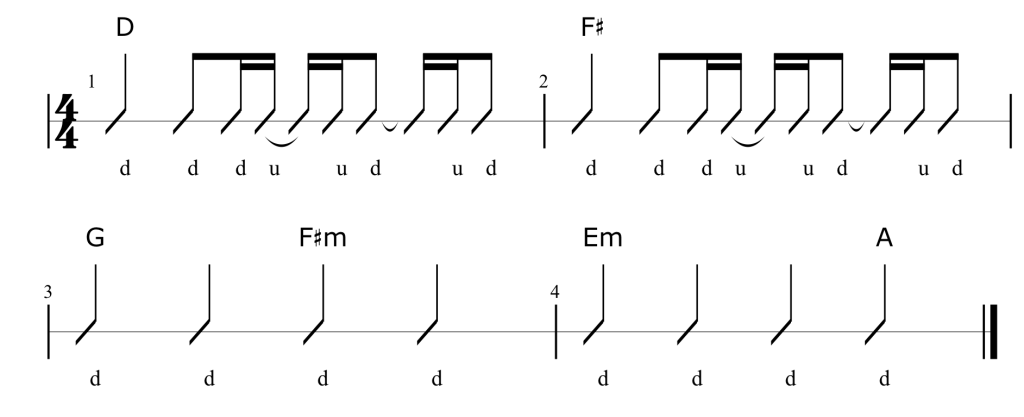
Intro, Verses, Break and Solo: The intro starts with all down strums (eight per chord). Then I switch to this pattern (which you can hear in the video below):
The xs indicated strums muted with the fretting hand. If you want a simpler strum that doesn’t use muting here’s one that takes the rhythm from the intro solo:
Which sounds like this:
Chorus: The chorus is much more straightforward. It’s all down-strums. One each on all the Gs and As. Two on the D. And three on the Bm. The exception is the last chorus where it’s just one down-strum per chord (and don’t forget the lenthened Bm chord).
Middle: Eight fast down-strums per chord. Until the final F#-G-A move where you do two slower down-strums per chord.
Twiddly Bits
Two little twiddles from the song. Both use the D major pentatonic include C# from the standard major scale.
Continuing this week’s Kitty Lux tributes with a live UOGB favourite: The Dam Busters March by Eric Coates. This isn’t a direct tab of their version but is heavily influenced by it.
I’ve divided up the duties in the piece so that each ukulele part has a different skill level. If you’ve got more players in your group you can divide these up further or devise your own complementary parts.
A load of tricky sections in this part (yet somehow it was the easy section at the end I managed to screw up in the video). The hardest section are the rapid-fire notes and moves up and down the neck in bars 40-44. But all the way through the first half there are bits that might trip you up. Luckily, things are much more stately in the second half.
I’m using fingerpicking to play this part. But it’s arranged in more of a UOGB than my usual style so it’s easier to play with a pick.
If, like me, you have no friends here’s a backing track to play this part along with:
The baritone tone is a little easier than the lead part. It’s mainly a simplified version of the lead part played an octave lower. The biggest challenges are the descending runs in bars 13 – 16 and bars 40-44.
Again, I’m playing this with my fingers but it’s arranged so it’s easy to play with a pick too.
I’ve kept this part as simple as possible. It’s all played with down-strums and it’s almost all beginner level chords.
There are a couple of slightly unusual sections where I’m just playing the top three strings. I’m playing these by strumming down with my thumb to give them a softer, rounder sound. But you don’t have to do that. And if you want to play all the strings it happens to be the second fret on the g-string that’s missing in every case.
With there already being plenty of Beatles ukulele material around, I tend to avoid adding to the pile. But I couldn’t resist having a go at adapting the gorgeous picking of Blackbird for ukulele. I love the rising and falling lines. Particularly the chromatic rise and fall on the E-string in bars 5-8 of the tab.
It’s a challenging piece to play on the uke. There’s plenty of movement up and down the neck and some tricky picking. There are also loads of time signature changes in the song. But none of them are jarring. So if you know the song well they’re going to feel natural.
– The pattern in bar 1 alternating index and middle fingers (picking the E- and A-strings respectively) and the thumb picking the g-string. – The pattern in bar 2 where the thumb alternates between the g- and C-strings.
There are 2 big exceptions. One is the picking is in bars 6 and 21. For those I’m alternating by thumb between the g- and E-strings. the other is bars 32-34 where I switch to strumming.
Jon was kind enough to let me post one of the tabs from his book and I picked Raggle Taggle Gypsies. The tune is a big favourite of mine with my favourite version being Martin Carthy’s. I recorded my own version based on his tab making a few changes to suit my style.
I may have to return to OK Computer for another tabbing or two. Every song on the record is incredible. But No Surprises stuck out as the one that’s prime for a ukeing.
In this arrangement I’ve tried to keep the fingerpicking riff going under the melody. Which works out pretty well for the most part. But you really do have to make sure you emphasise the melody notes or they can very easily get lost in the picking.
Towards the end I switch towards strumming. To make the melody easy to see I’ve tabbed up the backing strums as just being on the g, C and E strings. But it’s not a big deal if you hit all the strings.