Cartoon Network’s Over the Garden Wall has featured a bunch of old-timey musicians including Frank Fairfield, Jerron “Blind Boy” Paxton and ukulele chanteuse Janet Klein. I got had a request I couldn’t ignore for a song from the show so it was inevitable I went for Klein’s Langtree’s Lament.
Nothing too tricky in this arrangement. It’s almost all played with strums. There are some places when you’re not strumming all the strings e.g. bar 10. There the melody switches to the g-string so you need to emphasise that string. It’s not a big deal if you don’t hit exactly the strings tabbed so long as you’re holding the chord down (in that bar Bb7).
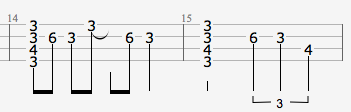
The notes I pick are the slides up to the fifth fret in bars 2 and 6, the one note in bar 7 and the campanella picking in bars 14 and 15. If you’re dead set against campanella you can also play it like this:
I’ve tackled Ray Parker Jr’s Ghostbusters theme once before way back in 2007. But I wanted to return to it to tidy it up and make it into a full instrumental version for a ukulele group. Also because it’s a stone-cold classic.
This version has five different ukulele parts of differing levels of difficulty (including one that just involves smashing the strings in time) and each one can be simplified or fancied up as suits.
This part takes care of all the chord work. For almost all the song the chords are just C – Bb – F. You can choose whichever inversion of those chords suits your playing.
This part plays the riff for most of the song. For the intro and middle sections I make use of campanella style. Letting close harmony notes ring into each other makes them extra spooky.
My original plan was to combine this part and the melody part. In the end I split them off so I could have the vocal part more prominent than this one. But the two parts are never playing at the same time so you can easily combine the two into one part if you wish.
The part starts of by plucking the strings with a pick between the nut and the pegs. It’s always high-pitched and out of tune up there so you’ll always get a spooky effect from it.
The intro spooky noises do include one additional uke. I scrapped a pick along a wound low-G string to get a bit of a creaking effect.
Percussive Uke
No notes at all in this part. I’m just muting all the strings with my fretting hand. I’m using two main patterns. The first one in the video I strum down right in front of the bridge to create a thud. Then up again in that area. Then and other down-up where the fretboard hits the body.
The next pattern is the same sort of idea. Start with the same down-up near the bridge. Then three down-ups at the fretboard.
The bridge strums do give you a good sound but they’re a bit tough on the fingers and not essential. You can also emphasise beats just be strumming more forcefully.
Back to the Future (Alan Silvestri): Alan Silvestri wrote the score to all the BttF movies but he was clearly channeling John Williams for the epic theme music.
Mr Sandman (The Chordettes): This one is already a bit of ukulele standard thanks to the opening lick being perfectly suited to re-entrant tuning.
Power of Love (Huey Lewis & the News): The first bit of this is just switching between different inversions of F and C. It shows how effective just changing up inversions can be.
Doubleback (ZZ Top & Alan Silvestri): The only part of the medley that doesn’t crop up in the Part I. It’s the tune from the ZZ Top bit in Part III. It’s supposed to be the ZZ Top song of the same name although any resemblance is lost on me.
Johnny B Goode (Chuck Berry. You know, Marvin’s cousin.): The climax of local rhythmic ceremonial ritual the Fish Under the Sea Dance and this medley.
The Dave Brubeck Quartet’s Take Five (written by the group’s saxophonist Paul Desmond) is an absolute instrumental classic. That’s why I started working on it in the early days of Uke Hunt (the 27th February 2008 according to the date on the file). Since then it’s been occasionally dragged out of the pile of half finished tabs but I haven’t had a version I was happy with until now. I hope it was worth the wait!
The song takes its name from its 5/4 time signature (i.e. there are five beats in a bar rather than the more common 3 or 4). You probably haven’t played in 5/4 time before but it’s not that hard to get the hang of. I find counting out the bars 1, 2, 3, 1, 2 gives you a good feel for the groove of the piece and you can drop the counting once you’re in the swing of it.
I haven’t played any of the Witcher games myself, but I checked out the soundtrack after getting a tab and it’s very much my sort of thing. I immediately picked up on Gwent Flute Song as being a good candidate for a ukuleling. It’s a fun pastiche of traditional Irish music which always sounds great played campanella style.
Unlike traditional tunes, which usually have two or three distinct sections that you switch between, Gwent Flute Song has a number of variations around a central theme. That means you’re using the same shapes throughout the tune but with subtle variations. That was a killer for me to memorize. If you want to cut down on the variation for your own version then go for it. I did that a bit myself. In my version bars 36 and 37 are the same as bars 40 and 41. Which isn’t the case in the original.
For most of picking in the piece I use thumb and two finger picking. But using my index on the C-string when it’s played next to the g-string e.g. bars 31 and 33.
The Brain Scoop is one of my favourite YouTube channels. It’s the channel of Emily Graslie who was working in a tiny museum in Missoula when Vlogbrother Hank Green featured her in a video and talked her into starting a YouTube channel. Now she works in the massive Field Museum making videos on everything they do from slicing open animals, to expiditions, to searching through their collections (including their ukulele). I highly recommend checking it out.
It also has a catchy theme tune (by general Nerdfighteria producer Michael Aranda) that I had to do a uke version of. I’m very excited that it got the Brain Scoop and Hank Green seal of approval.
I was inspired to arrange this one by Brooke Pallson’s ukulele version and somehow it’s taken me two years to get from that to a finished version. That might suggest it’s a deeply complex arrangement but it’s pretty easy to play (although I still manage to jack it up at about 1:20 in the video).
The trickiest bit is the solo section that starts in bar 31. The first four bars ape the keyboard solo and the next for the “ain’t nobody’s business” vocalising. It took me a bit of practice to be able to switch between those. They’re just similar enough and just different enough to make it tricky.
If you’ve been following my riffs for ukulele series, you’ll have heard me encourage you to use it more creatively than just playing one riff at a time. One way to use them is to cram a bunch of them together to make a melody. That’s what I did with my Arctic Monkeys medley and this collection of Strokes riffs.
The songs in this medley are:
Barely Legal/Take It Or Leave It/Hard to Explain/12:51/One Way Trigger/Reptilia/Barely Legal (again)/Someday/Under Cover of Darkness/Last Nite
After last week’s two nightmaredifficulty posts something much more straight forward this week.
Like the original, I start my version off with just the melody. It’s a great traditionally inspired melody (written by the guys off of The Lumineers) and is plenty strong enough to hold your attention alone. I’m just picking this with my thumb but you can use fingers if you’re comfortable with that.
Then from bar 17 I introduce a few chords but still keep it very minimal. Again, I’m just using my thumb to play these. Strumming down the strings whenever there’s more than one note.
I had to do this tab to celebrate the finale of the first series of Serial. The plinkiness of it was just dying to be uked. To keep it extra-plinky it’s played right up the neck.