One of the many areas the BBC excels in is the exceptionally nerdy quiz show. I can’t imagine anyone else coming up with museum based quiz or a show like Only Connect where questions are chosen via Egyptian hieroglyphs.
Connecting Only Connect to ukuleles is very easy. Season three winner Jenny Ryan (who went on to become The Vixen on The Chase) is a keen uker with the excellently named Nanukes of the North.
I’ve raved about Hitman before on here. But I haven’t given enough praise for how much the music adds to the experience. The music works to subtly differentiate different areas of the maps and set the mood for each one.
This excellent little guitar piece is used to evoke a small Columbian fishing village which is relaxed on the surface but houses a huge drug operation. Similarly, the tune is relaxed and easy-going with a few little hints of darkness peaking through.
I’ve kept my version very simple. I’m only using the top three strings picked thumb and two finger style. The most important thing is to give the melody notes a little extra umph so they stand out against the backing notes.
I Remember You is heartbreaking beautiful song from 1941 by Victor Schertzinger and Johnny Mercer. My favourite versions of this are by Ella Fitzgerald and Bjork. But, bafflingly, Frank Ifield’s bizarre yodelling cowboy version is the most well known. You won’t be surprised to learn my arrangement is based on the former two.
This song is part of my jazz odyssey series where I’m trying to increase my understand of jazz theory and putting it into practice. Instead of focussing on jazz licks like I did in Ja-Da and Summertime, this time I’m focussing on chords. So there are many 7, maj7, 6, and b5 notes thrown in. Hopefully, in a way that they flow together and don’t sound contrived.
Christmas came early for depressed weirdos last week with the surprise release of Bon Iver’s new album i,i. The record is a perfect blend of his previous three albums. The acoustic track Marion is the most like his debut album and so obviously suited for a ukulele cover I started working it out during my first hearing of it.
I’m playing it with a capo on the third fret to keep it in the original key of Eb. But it does stray high up the neck so you might want to ditch it if you’re using a soprano uke.
It’s not too difficult to play. The only big stretch comes in bars 10-11. Everything else is plain sailing. I’m very loose with the timing in the song. Spreading out and compressing notes to add feeling to the song. So I encourage you to do the same.
After doing a round, I thought I’d take things one step further and have a go at playing two different melodies at once (a “simultaneous quodlibet” if you want to use the technical term). You quite often get different melodies played over each other in modern music (such as Tori Amos’s Father Lucifer). Sometimes it forms the entire basis of the song like The Beta Band’s The House Song.
I went two songs with very simple melodies: When the Saints Go Marching In and She’ll Be Coming ‘Round the Mountain. With them both in the key of C, I’d play them individually like this:
They actually fall quite nicely together on ukulele. Particularly if you take advantage of the re-entrant string and move some of the E-string, third frets in When the Saints to the open g-string.
Next job is to adjust parts where the same string is played at different frets and where there are impossible stretches. For example, at the end of bar 2 Saints has the E-string played at the first fret while Mountain has it played at the tenth fret. Moving the Saints note to the C-string, fifth fret and the Mountain note to the A-string, fifth fret makes it playable.
Just doing those things makes for a playable arrangement. Except for one note. At the end of bar 4 Saints has a note on the C-string, second fret while Saints has a note on the A-string, 8th fret. Too big a stretch for me to switch to that quickly. So I examined the lives of the rich and successful to see what they do when faced with a challenge. And I cheated. I switched the C-string, second fret to an open E-string. No-one on Instagram noticed so I think I got away with it.
I first tabbed up this tune 11 years ago (almost to the day) but never got around to doing a video of it. But having finally got around to watching the final season (I dropped out because season 8 was so awful) I finally got around to making one.
I made some minor changes so I’ve redone the tab.
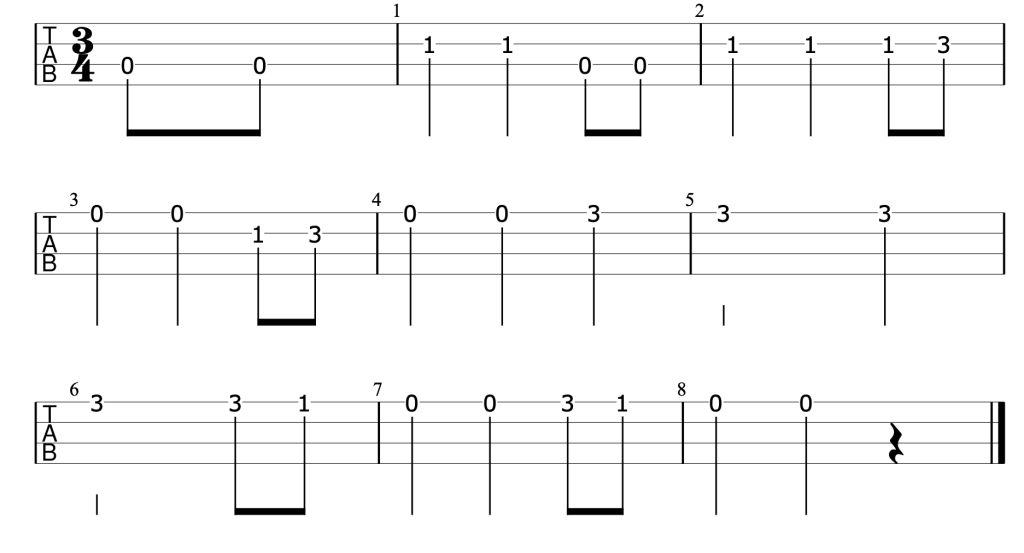
Dunder Mifflin Jingle (People Person’s Paper People)(Tab)
While I was at it, I also felt the need to tab the Dunder Mifflin jingle from the Local Ad episode. I’ve tabbed the first version from the episode. Which was written by, BoJack Horseman composer and brother of BJ, Jesse Novak.
I love Blackpink’s willingness to hurl every idea and genre into one song. Kill This Love starts with blaring brass, goes through rapping, diva crooning and girl-power yelling before switching from swing-time to march-time for a militaristic outro.
Keeping up with all that on a ukulele takes a variety of techniques. In the intro I strum the big blasts at the start of bars 1 and 3 and pick everything else. The verses are fingerpicked and played very staccato (i.e. keeping the notes short). I miss out the, “Here I come kicking the door,” section and move straight into the pre-chorus. This continues the staccato playing in the first half before being played more smoothly from bar 21.
Heading into the chorus, I use a triplet strum (strumming down with my middle and index fingers, down with my thumb then up with middle and index). Then I blast out the chorus with as much strum power as I can manage while strum blocking any notes I don’t want to sound.
The outro starts with some thumb and two finger picking with the thumb on the C-string having duel duties picking the melody and providing a steady beat.I make a bit of a hash of the final part of the outro. So follow the tab rather than the video here. But blast it out as loud as you can.
For my version, I with a capo on the 4th fret. Making it the same key as the original. But there’s nothing stopping you playing it without a capo if you’re not playing along with the recording.
There are a couple of sections in this song that are full of swoops, whoops, beeps and boops that don’t transfer particularly well to uke. Which makes for the perfect opportunity to come up with your own parts.
The first of these comes in the intro. For that I took the notes in the melody and fingerpicked them campanella style to create a shimmering effect.
The second part is the solo. There I let the g and E strings ring out to produce the Em backing while playing octaves on the C and A strings using the E minor scale.
I highly recommend you play around and try to find something you like for your own version.
The last few tabs have been at the trickier end of the scale. So for this one I’ve gone super-simple. The melody for this song is so great it benefits from having very minimal backing.
The whole arrangement is played with just the thumb on the picking hand. And most of the chord shapes used will be very familiar to you. The only time it ventures up the neck is the high variation on, “nothing compares,” right at the end. It’s a bit of stretch. So if you’re struggling you can stick with the way it’s played in previous bars. Or you can replace the 55 at the start of bar 32 with an open C-string.