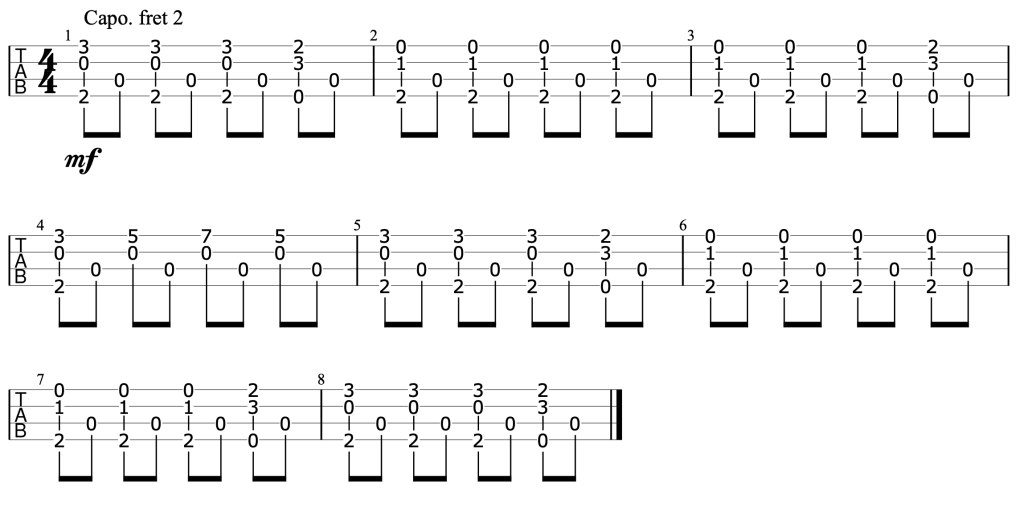
With the song being four part harmony it makes sense to use all the strings for this one. So I’m mostly strumming the tune here. Just a few notes here and there picked out.
I also throw in a few triplet strums inspired by the banjoleling. For the triplets I’m doing: down with index, down with thumb, up with middle.
Two songs bashed together here. The opening, Dr Zaius, song is mostly strumming and the second, Chimpan-A to Chimpanzee, is all fingerpicking apart from the triplet strums at the end. I’m using a different triplet strum here. I’m doing: down with middle, up with index, up with middle.
Rounding off Valentine’s week with one of the few lovey-dovey songs I actually like. Make You Feel My Love first cropped up on Bob Dylan’s Out of Time (a record that was seen as Dylan’s “I’m nearly dead” album when it came out twenty years ago). But it became much more widely known when Adele covered it on 19. My arrangement leans towards the Adele version. But there’s not a lot to choose between the two anyway.
I’ve kept the arrangement very simple. I’m mostly using thumb and two finger picking. The only exception is when I strum all the strings with my thumb in bars 7, 24 and 26. But it is arranged in such a way that you could play the whole thing with your thumb.
The one part that might be a challenge is the jump down the neck between bars 10 and 11.
One of 2017 most unexpected hits. Portugal. The Man have been knocking around for years without bothering the charts. But last year’s instantly catchy Feel It Still changed that. And made me tackle arranging it despite it being not immediately uke-suitable. So this one is a bit tricky to play and uses a range of techniques.
The arrangement starts with the bass riff which sets up the C – Eb – F chord progression that is used through most of the song. (The original is in the key of C# so you play in the original key by putting a capo on the first fret.) In this section I’m muting the strings slightly by lightly resting the palm of my picking hands on the strings. The muffled sound makes the melody stand out more once it comes in.
In the spirit of, “Don’t bore us, get to the chorus,” the verses are ultra short. It’s all played with fingerpicking with thumb, index and middle fingers.
You can blast out the choruses by bringing in the strums. The tricky part is fitting the strums around the rapid fingerpicking required. I’m using a lot of alternate picking to fit them in. I’m also flicking my index finger up when picking some notes to create a fuller sound.
Since it’s Christmas, I’m breaking my no Beatles rule to do this one I’ve had a fair few requests for over the years.
I’ve kept the arrangement as simple as possible. After the fingerpicking in the first bar it’s all strumming and lots of familiar chord shapes. And the melody is recognisable you don’t have to worry about emphasising it all that much. I’m using a capo at the first fret which puts it in the same key as the original. But you can just play it open if you prefer.
The only thing that might trip you up are the extra beats that he throws in. There’s one extra beat in the middle of the verse and two extra at the end.
In case you’re not familiar with the Italian repeats in the tab. You play through as normal up to the “D.S. al coda” in bar 29. Then you go back to the squiggle in bar 13. Play through to the “Da Coda” in bar 23. Then skip ahead to the target symbol in bar 30.
There’s nothing massively challenging in this arrangement but there are a few leaps up and down the fretboard. You can make things a easier with a bit of planning though. In bars 10 and 12 moving your hand up so you play the 3rd fret with your index finger makes it a much easier transition into the next bar.
Cuphead is the most hyped game of the year. Unfortunately, I don’t own anything that can play it because I still haven’t forgiven Microsoft for Vista. So I’ve contented myself with playing the soundtrack. And a very good soundtrack it is too.
Like the game’s visuals, the music apes styles of the 1930s. So there’s plenty of big band jazz, ragtime piano and in Don’t Deal with the Devil barbershop.
To keep that barbershop feel I’m using fingerpicking rather than strumming in my arrangement. That means you can play all the notes at once as they sound in the original.
You might not have heard of Plied Sound before but there’s a good chance you’ve heard their music. They’ve scored ads for numerous companies. Most notably Apple. So if you’ve ever listened to Jonny Ive being precious about unibody aluminium and chamfered edges you’ve probably heard Plied Sound.
But they ditched the epic piano and spacey bleeps and bloops for the excellent, folky and ukulele-heavy soundtrack for Burly Men at Sea.
For my version of The Brothers Swim I’m using a low-G ukulele. In the first section, the thumb is picking everything on the G- and C-strings with the other notes played using alternate picking. In the second section (bar 9 onwards) I use one finger per string picking.
Being a walking simulator fan, I loved this game. The highlight for me was the glorious, Bafta winning soundtrack. It was written by Jessica Curry and is full of pastoral, Vaughan Williams style pieces. The Mourning Tree is an adaptation of the traditional British melody Down in Yon Forest which I tabbed in Christmas Ukulele III. When it cropped up in the game it took my breath away and I had to work up a version.
You could just about play this arrangement with just the thumb on the picking hand. But I’m using one finger per string picking up until bar 19. Then I use alternating index and middle fingers for the quick run and throw in some thumb and two finger picking.
I’ve done a ton of Life is Strange tabs and chords already. But there’s always room for more. Particularly since the prequel is currently halfway through its release. Speaking of which…
The Life is Strange prequel Before the Storm has taken a different direction with the music. Instead of a variety of acts, all the music is provided by the band Daughter. Which has made the soundtrack markedly less exciting to me.
But the use of No Care at the start of episode two saved what could otherwise be a slightly ridiculous scene.
The riff is challenging to play on ukulele but it’s just about possible.
Fats Domino’s version of Blueberry Hill perfectly shows off the roots of rock and roll. He plays the driving boogie-woogie and has blues riff bassline. But the song itself is a country song first released by Gene Autry. So you have this sweet, major key country melody rubbing up against bluesy runs and liberal use of the minor third (the C-string, 3rd fret in my tab).
I’ve tried to keep those two elements in my arrangement of the tune. The verses have the melody with the bassline sitting between the lines (now not at all bassy). Try to separate these by playing the melody a bit louder (I didn’t do a great job of this in the video). The, “Wind in the willow…” section lays off the bassline and has chord stabs in between the melody. Keep those short by releasing the pressure with your fretting hand just after you strum.
To finish the song off I’ve added a little blues run. A great place to throw in your own favourite blues licks and play around.
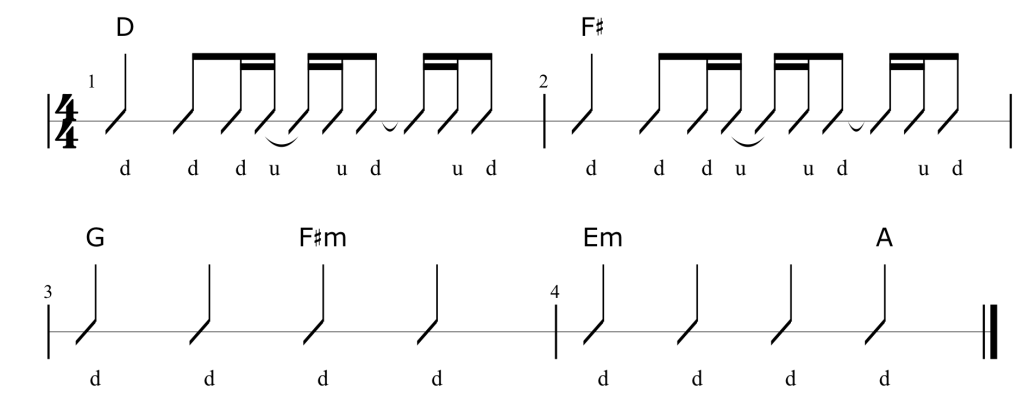
The chord that really makes this progression is the F# (the major III chord in theory terms). In the key of D you’d expect to hear and F#m (which also crops up the progression). The Bb note in the F# chord doesn’t fit in the D major key so in creates loads of tension until it becomes more settled in the G chord. It’s a classic chord trick. You can hear the same move (I – III – IV) in the chorus of Tennesee Waltz.
Mardy Strum
Intro, Verses, Break and Solo: The intro starts with all down strums (eight per chord). Then I switch to this pattern (which you can hear in the video below):
The xs indicated strums muted with the fretting hand. If you want a simpler strum that doesn’t use muting here’s one that takes the rhythm from the intro solo:
Which sounds like this:
Chorus: The chorus is much more straightforward. It’s all down-strums. One each on all the Gs and As. Two on the D. And three on the Bm. The exception is the last chorus where it’s just one down-strum per chord (and don’t forget the lenthened Bm chord).
Middle: Eight fast down-strums per chord. Until the final F#-G-A move where you do two slower down-strums per chord.
Twiddly Bits
Two little twiddles from the song. Both use the D major pentatonic include C# from the standard major scale.
There is a lot going on in this song. Slate claims it has 18 key changes in it. But you have to be very generous to get that high. For the most part I think of the song being in C but using both C major and C minor. That’s not too unusual in a rock song. But it is unusual just how much they do it and how far they stretch things before returning home.
The one real key change comes in the solo/middle section where the F#m and E set up a repeat of the intro but this time in the key of A rather than C.
I’m throwing a whole bunch of different techniques at this song. In the smooth sections (the intro and middle) I’m using fake strums. In the loud bits (like the start of the chorus and the bridge) I’m strumming. In the bouncy sections (like the end of the intro and the, “Not to put too fine a point…” bit of the chorus) I’m using thumb and two finger picking. And at the end of the chorus, in the verses and the solo I’m using one finger per string picking.
I had to make a change to the scheduled chord post to pay tribute to the incredible soul singer Charles Bradley who died last week. Bradley spent most of his life in complete obscurity as the singer in a James Brown tribute act until the incomparable Daptone Records picked him up and released his debut album in 2011 at the age of 62. The album contained some of the most powerful and heartfelt soul music of the decade and made him an almost instant soul legend.
But most pertinent here is the ukulele track Dusty Blue from his second album with the Menahan Street Band (a track that later popped up on Suits). It’s one of the few ukulele-led soul tracks out there. If you watch careful you can see the studio ukulele in the Charles Bradley documentary Soul of America.
I recorded a version of Dusty Blue a few years ago but never got around to posting the tab. So here, at last, it is.