I did a tab for the intro of King of Spain a few years ago. But I love that song and had to extend it out into a full instrumental version of the song. The song can be played with mostly strums and barrels along at a good pace so it’s perfect for a ukeing.
Tuning
I’m using open-F tuning to mimic the open-C version of the original. You get that by tuning the g-string down to F and the E string up to F.
The main chords used are F (0000 and 0003), Dm (0200), Bb (0201) and Cadd11 (0403).
Trickiest Bit
In bar 5 there’s a chord played with 7th fret harmonics. If you’re having trouble hitting that cleanly try playing the harmonics at the 12th fret. There’s more room for error there and you get the same effect.
Other than that I’d recommend barrelling along with it and not worrying to much about the occasional flub (as demonstrated in my version).
Death with Dignity is a beautiful song by Sufjan Stevens about the death of his mother (a subject that clearly resonates with Kanye West). The song is heavy with grief backed with sparse, shimmering ukulele. And idiots will still tell you it’s impossible to be sad when playing a ukulele.
I think he’s using open C-tuning for this which is gCEG (i.e. tune your A-string down so it’s the same pitch as the g-string). Then capo at the fourth fret.
This part is really quiet on the record so I’m making it up about half the time. Take that as a free pass to mess around with this part and play it how you feel it. I’m guessing it’s played on a classical guitar but it works perfectly well on baritone.
Happy St Patrick’s Day! To celebrate I arranged my favourite song by my second favourite Irish songwriter (can’t can The Van).
One of the things I love about arranging tunes is noticing little things that completely passed me by listening casually. I didn’t realise that the melody in the chorus shifts against the chords. The basic chords though the whole song are Am-F-C-G. The first, “Is that alright?” is on the Am and later it’s on the F chord. Of course, I completely ruin it by arranging them both exactly the same way.
Cartoon Network’s Over the Garden Wall has featured a bunch of old-timey musicians including Frank Fairfield, Jerron “Blind Boy” Paxton and ukulele chanteuse Janet Klein. I got had a request I couldn’t ignore for a song from the show so it was inevitable I went for Klein’s Langtree’s Lament.
Nothing too tricky in this arrangement. It’s almost all played with strums. There are some places when you’re not strumming all the strings e.g. bar 10. There the melody switches to the g-string so you need to emphasise that string. It’s not a big deal if you don’t hit exactly the strings tabbed so long as you’re holding the chord down (in that bar Bb7).
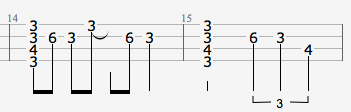
The notes I pick are the slides up to the fifth fret in bars 2 and 6, the one note in bar 7 and the campanella picking in bars 14 and 15. If you’re dead set against campanella you can also play it like this:
I’ve gone with a chord arrangement for most of the tune. That means I’m just holding down chords and strumming. Then emphasising the melody while letting the other strums hang back.
The other main technique is picking the C-string with my thumb and flicking my index finger up across the E- and A-strings. I do that right at the start of the verse (second half of bar 4) and in the, “In the meadow…” section (bars 14-19).
The only bit of pure fingerpicking comes in the descending line in bar 20.
This lovely PCO tune is a duet between ukulele and cuatro. But it also stands up very well as a solo ukulele piece.
If you do have a spare cuatro player laying around the tab is exactly the same. They take advantage of the fact the uke and cuatro are tuned to the same notes (in this case D-tuning: ADF#B) but the A- and B-strings on the cuatro are an octave below those on the uke. That means the same tab played on both creates two different melodies that fit together perfectly. It’s a neat trick.
For my version I was too lazy to move to D-tuning so I just stayed in C-tuning and put a capo on the second fret to get the same result.
I love this live version of Paul’s Dance so I worked from that one. There are a few differences between this and the album version. The most obvious is that the live version uses more changes in pace and dynamics.
I’ve tackled Ray Parker Jr’s Ghostbusters theme once before way back in 2007. But I wanted to return to it to tidy it up and make it into a full instrumental version for a ukulele group. Also because it’s a stone-cold classic.
This version has five different ukulele parts of differing levels of difficulty (including one that just involves smashing the strings in time) and each one can be simplified or fancied up as suits.
This part takes care of all the chord work. For almost all the song the chords are just C – Bb – F. You can choose whichever inversion of those chords suits your playing.
This part plays the riff for most of the song. For the intro and middle sections I make use of campanella style. Letting close harmony notes ring into each other makes them extra spooky.
My original plan was to combine this part and the melody part. In the end I split them off so I could have the vocal part more prominent than this one. But the two parts are never playing at the same time so you can easily combine the two into one part if you wish.
The part starts of by plucking the strings with a pick between the nut and the pegs. It’s always high-pitched and out of tune up there so you’ll always get a spooky effect from it.
The intro spooky noises do include one additional uke. I scrapped a pick along a wound low-G string to get a bit of a creaking effect.
Percussive Uke
No notes at all in this part. I’m just muting all the strings with my fretting hand. I’m using two main patterns. The first one in the video I strum down right in front of the bridge to create a thud. Then up again in that area. Then and other down-up where the fretboard hits the body.
The next pattern is the same sort of idea. Start with the same down-up near the bridge. Then three down-ups at the fretboard.
The bridge strums do give you a good sound but they’re a bit tough on the fingers and not essential. You can also emphasise beats just be strumming more forcefully.
Back to the Future (Alan Silvestri): Alan Silvestri wrote the score to all the BttF movies but he was clearly channeling John Williams for the epic theme music.
Mr Sandman (The Chordettes): This one is already a bit of ukulele standard thanks to the opening lick being perfectly suited to re-entrant tuning.
Power of Love (Huey Lewis & the News): The first bit of this is just switching between different inversions of F and C. It shows how effective just changing up inversions can be.
Doubleback (ZZ Top & Alan Silvestri): The only part of the medley that doesn’t crop up in the Part I. It’s the tune from the ZZ Top bit in Part III. It’s supposed to be the ZZ Top song of the same name although any resemblance is lost on me.
Johnny B Goode (Chuck Berry. You know, Marvin’s cousin.): The climax of local rhythmic ceremonial ritual the Fish Under the Sea Dance and this medley.
The Dave Brubeck Quartet’s Take Five (written by the group’s saxophonist Paul Desmond) is an absolute instrumental classic. That’s why I started working on it in the early days of Uke Hunt (the 27th February 2008 according to the date on the file). Since then it’s been occasionally dragged out of the pile of half finished tabs but I haven’t had a version I was happy with until now. I hope it was worth the wait!
The song takes its name from its 5/4 time signature (i.e. there are five beats in a bar rather than the more common 3 or 4). You probably haven’t played in 5/4 time before but it’s not that hard to get the hang of. I find counting out the bars 1, 2, 3, 1, 2 gives you a good feel for the groove of the piece and you can drop the counting once you’re in the swing of it.
I haven’t played any of the Witcher games myself, but I checked out the soundtrack after getting a tab and it’s very much my sort of thing. I immediately picked up on Gwent Flute Song as being a good candidate for a ukuleling. It’s a fun pastiche of traditional Irish music which always sounds great played campanella style.
Unlike traditional tunes, which usually have two or three distinct sections that you switch between, Gwent Flute Song has a number of variations around a central theme. That means you’re using the same shapes throughout the tune but with subtle variations. That was a killer for me to memorize. If you want to cut down on the variation for your own version then go for it. I did that a bit myself. In my version bars 36 and 37 are the same as bars 40 and 41. Which isn’t the case in the original.
For most of picking in the piece I use thumb and two finger picking. But using my index on the C-string when it’s played next to the g-string e.g. bars 31 and 33.