Finishing off cartoon week with an exceptionally catchy tune that set the standard for yelling “woo hoo!”. And it’s particularly relevant to give it a ukeing now that the rejiggered series features Uke Hunt favourite Kate Micucci.
The song includes a subtle key change with the chorus being a whole step higher the second time around. To keep things easy to memorise, I’ve arranged it so it’s played exactly the same but two frets higher second time around.
The last few tabs have been at the trickier end of the scale. So for this one I’ve gone super-simple. The melody for this song is so great it benefits from having very minimal backing.
The whole arrangement is played with just the thumb on the picking hand. And most of the chord shapes used will be very familiar to you. The only time it ventures up the neck is the high variation on, “nothing compares,” right at the end. It’s a bit of stretch. So if you’re struggling you can stick with the way it’s played in previous bars. Or you can replace the 55 at the start of bar 32 with an open C-string.
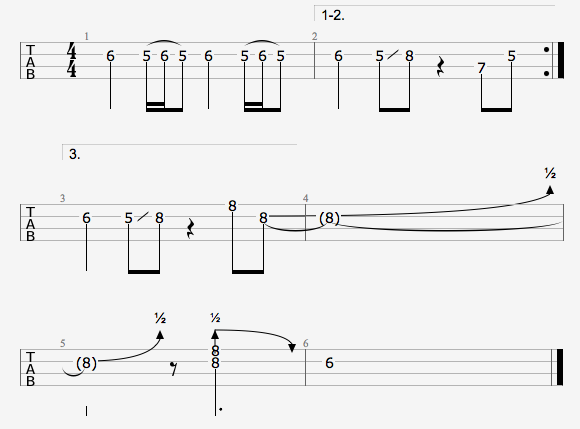
I don’t know what possessed the nabobs at the Thomas corporation to replace the fantastic original Thomas theme with a piece of detestable ear-dreck. The new one has nothing as tasty as that chord change from C to Ab, the chromatic runs and the syncopation.
This year’s Star Wars Day inspired me to work up a version of John Williams’s ultimate bad-guy theme tune The Imperial March. If you’re interested in the theory behind how this tune conjures up the dark, powerful, militaristic images I highly recommend watching 12tone’s video on the tune.
The trickiest part of the arrangement is the legendary rhythm at the beginning. It involves three quick triplets. It’s one to practice very slowly and gradually speed it up.
I’m using a slight variation on the traditional Hawaiian triplet strum:
– Down with index finger. – Down with thumb (indicated by dt in the tab). – Up with index.
The variation is that I’m strumming down with my index and middle fingers together to give it more power and make sure the force is strong in this one. Here’s how the strum looks slowed down:
I also had problems with this because of the rhythmic mismatch between the triplets in the rhythm part and the dotted eighth notes in the melody (mentioned in the 12tone video). I had a hard time switching between the melody in bar 14 to the strumming in bar 15.
A quick bonus tab. In tribute to Roger Bannister I knocked together a simple version of the Chariots of Fire theme tune. There were a bunch of requests for a tab so here it is.
There is a lot going on in this song. Slate claims it has 18 key changes in it. But you have to be very generous to get that high. For the most part I think of the song being in C but using both C major and C minor. That’s not too unusual in a rock song. But it is unusual just how much they do it and how far they stretch things before returning home.
The one real key change comes in the solo/middle section where the F#m and E set up a repeat of the intro but this time in the key of A rather than C.
I’m throwing a whole bunch of different techniques at this song. In the smooth sections (the intro and middle) I’m using fake strums. In the loud bits (like the start of the chorus and the bridge) I’m strumming. In the bouncy sections (like the end of the intro and the, “Not to put too fine a point…” bit of the chorus) I’m using thumb and two finger picking. And at the end of the chorus, in the verses and the solo I’m using one finger per string picking.
I wrote up the chords for Hallelujah way back in 2008. But, since it’s a huge hit with ukulelists, I wanted to do an instrumental version as a little tribute to Leonard Cohen. And a tribute to Jeff Buckley since the intro is completely ripped off from his incredible version.
I try to keep most of my tabs fairly disciplined and work them up fully beforehand. It’s easier for people to read and learn that way. But be warned: this one I played pretty freely then tabbed out what I played. So the fingerpicking is all over the place.
In the verse the melody is everything played on the A-string plus the third fret of the E-string. Everything else is backing so should be played a little more softly. The chorus is more strange since the melody notes are played on the g-, C- and E-strings. I’ve notated all the melody notes with an accent > above them.
This is a follow on from the Hanging Tree tab in a few ways. As well as the Hunger Games connection, I’ve tried to keep the arrangement as minimal and easy to play as possible.
The arrangement draws heavily on Lorde’s sparse, minor key version. But it also includes elements of the Tears for Fears original since I couldn’t get that version out of my head.
I use thumb and two finger picking for my version but it’s arranged so you can play it all just using your thumb.
A few weeks ago I wrote about Prince’s favourite chord trick and it lead to an inevitable cavalcade of requests for Purple Rain. And why not? It has to be one of the best chord progressions ever written.
Suggested Strumming
Here’s the slightly sparse strumming pattern I like to play:
d – – – d – d u – u – – d u d u
You can use that everywhere except the few chords he strums once then brings a halt to the backing.
Twiddly Bits
I’m not going to write up the whole solo but here’s the little repeating motif:
Towards the end of the song this little run is introduced at the end of the chord progression:
If you’re really adventurous you can play it with full chords. Here’s how it sounds (easy version then hard):
This lovely PCO tune is a duet between ukulele and cuatro. But it also stands up very well as a solo ukulele piece.
If you do have a spare cuatro player laying around the tab is exactly the same. They take advantage of the fact the uke and cuatro are tuned to the same notes (in this case D-tuning: ADF#B) but the A- and B-strings on the cuatro are an octave below those on the uke. That means the same tab played on both creates two different melodies that fit together perfectly. It’s a neat trick.
For my version I was too lazy to move to D-tuning so I just stayed in C-tuning and put a capo on the second fret to get the same result.
I love this live version of Paul’s Dance so I worked from that one. There are a few differences between this and the album version. The most obvious is that the live version uses more changes in pace and dynamics.