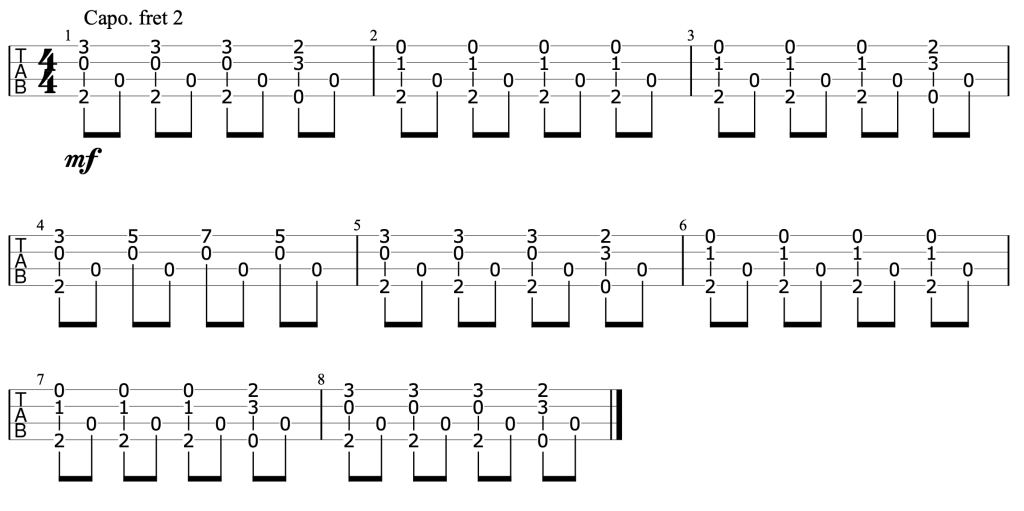
Part two of Game Day and this time it’s a song from the video game Pyre suggested by patron Xavier. I’m using a capo on the 4th fret to keep it in the same key as the original. But there’s no reason you can’t play it without one if you prefer.
The arrangement has three main sections. It starts with just the melody. I’m using one finger per string picking here but you can pick it in whatever way suits you. The second section adds chord backing to the melody. I would recommend using one finger per string picking here but you could use thumb strumming. The final section has the C-string plucked and a strum with a few little twiddles. I’m using whatever finger comes to hand here so go hog wild.
I’ve raved about Hitman before on here. But I haven’t given enough praise for how much the music adds to the experience. The music works to subtly differentiate different areas of the maps and set the mood for each one.
This excellent little guitar piece is used to evoke a small Columbian fishing village which is relaxed on the surface but houses a huge drug operation. Similarly, the tune is relaxed and easy-going with a few little hints of darkness peaking through.
Cuphead is the most hyped game of the year. Unfortunately, I don’t own anything that can play it because I still haven’t forgiven Microsoft for Vista. So I’ve contented myself with playing the soundtrack. And a very good soundtrack it is too.
Like the game’s visuals, the music apes styles of the 1930s. So there’s plenty of big band jazz, ragtime piano and in Don’t Deal with the Devil barbershop.
To keep that barbershop feel I’m using fingerpicking rather than strumming in my arrangement. That means you can play all the notes at once as they sound in the original.
You might not have heard of Plied Sound before but there’s a good chance you’ve heard their music. They’ve scored ads for numerous companies. Most notably Apple. So if you’ve ever listened to Jonny Ive being precious about unibody aluminium and chamfered edges you’ve probably heard Plied Sound.
But they ditched the epic piano and spacey bleeps and bloops for the excellent, folky and ukulele-heavy soundtrack for Burly Men at Sea.
For my version of The Brothers Swim I’m using a low-G ukulele. In the first section, the thumb is picking everything on the G- and C-strings with the other notes played using alternate picking. In the second section (bar 9 onwards) I use one finger per string picking.
Being a walking simulator fan, I loved this game. The highlight for me was the glorious, Bafta winning soundtrack. It was written by Jessica Curry and is full of pastoral, Vaughan Williams style pieces. The Mourning Tree is an adaptation of the traditional British melody Down in Yon Forest which I tabbed in Christmas Ukulele III. When it cropped up in the game it took my breath away and I had to work up a version.
You could just about play this arrangement with just the thumb on the picking hand. But I’m using one finger per string picking up until bar 19. Then I use alternating index and middle fingers for the quick run and throw in some thumb and two finger picking.
I’ve done a ton of Life is Strange tabs and chords already. But there’s always room for more. Particularly since the prequel is currently halfway through its release. Speaking of which…
The Life is Strange prequel Before the Storm has taken a different direction with the music. Instead of a variety of acts, all the music is provided by the band Daughter. Which has made the soundtrack markedly less exciting to me.
But the use of No Care at the start of episode two saved what could otherwise be a slightly ridiculous scene.
The riff is challenging to play on ukulele but it’s just about possible.
I think I’m getting soft in my old age. Over the winter break I played two games that ended with me in floods of tears: Valiant Hearts and Life is Strange. Now I can’t even get through the Valiant Hearts trailer or Spanish Sahara without misting up.
I’m a sucker for great music in games (obviously) and Life is Strange has both an excellent original score and tracks from some of my favourites like Jose Gonzalez, Alt-J, Mogawai plus some uke in the form of Amanda Palmer’s In My Mind.
The melody line of the Max and Chloe theme is slow, simple and absolutely beautiful. There’s lots of room for you to add emotion to it so be sure to use plenty of vibrato.
This part – played on a standard tuned ukulele – is much trickier than the lead part. The thumb and two finger picking pattern is constant and rapid. So be sure to warm up well before tackling it.
The baritone part is much more simple. It starts out just some softly played low notes to fill out the sound. It breaks from that at the start of verse two to double the melody an octave down.
The trailer itself provides another musically treat in the form of Ellie covering Through the Valley by Shawn James. The song is so perfect I assumed it had been written for the trailer.
I cobbled my version together quickly. I started as soon as I saw the trailer and recorded the video the next day. So it is a bit all over the place. The plan was to put the melody firmly up front and put the picking in softly between melody notes. And it mostly works that way. The notes on the g- and C-strings are played with the thumb, the index finger handles the E-string and the middle finger the A. The only exception is when all the strings are plucked at once.
The Walking Dead theme uses a technique I should have included in my spooky ukulele sounds post: unusual timings. Each bar has a pattern that rises and falls twice but then cuts off half way through the third time. The bars themselves are played an odd number of times. The first pattern is played three times at the beginning in my version (seven in the original) and five times at the end. Usually you see bars in powers of 2 (1, 2, 4, 8 etc.) or at least an even amount. Having an even number gives it a unsettling feeling.
I went with low-G tuning here. It makes it so much easier to play. But I like the way it sounds even on high-g. Even spookier if you ask me.
The tune is very simple. It’s just one pattern on three different locations on the neck. It’s great for practicing your thumb and two finger picking. I’ve been using it as a little warm up exercise. The great part is you can move the pattern up and down the neck and it always works.
I do enjoy a good fake-Celtic game tune like Gwent Flute Song from Witcher 3. So when I got a request for this tune I couldn’t resist. I might make it a trilogy and do the Hearthstone theme at some point. Until then I’ll keep brushing up on actual Celtic tunes.
For my version I’ve kept the chords and melody separate. The melody is a good opportunity to use a pick to get a mandolin-ish tone. But I’m using my fingers mostly alternating picking with index and middle fingers.
Here’s a backing track for you to play along with. There’s one bar of Am to count you in.
For the backing strumming I’m using a touch strum then a full strum. There’s a full guide to touch strums in How to Play Ukulele Strums but the basics is you lightly hit just the g- and C-strings with your strum.
A primer for the uninitiated: Neko Atsume it a mobile game where you lure increasingly fancy cartoon cats to your yard. Until recently it was only in Japanese and inscrutable to non-Japanese speakers.
In short, it has all the ingredients to make it an inevitable massive hit. Including the most important: a smooth, lounge-jazz soundtrack (the favourite music of all cats). And Neko Atsume delivers with chilled major 7 and 9 chords just crying out for a ukulele cover.
I play this part on a standard C-tuned uke with a capo on the second fret (so it’s the same as D-tuning).
There are a few big jumps up and down the fretboard. It took me a good amount of practice to get them smooth. Also, when you’re leaping up the fretboard remember that the capo means that you actually play two frets higher than indicated (not a problem if you’re using D-tuning, of course).
If you just want to play the melody part, here’s a backing track for you:
If, on the other hand, you want to play the backing part (or you have a friend who does) you’re going to need a baritone ukulele and a mellow, cat-like outlook on life. I highly recommend stealing a few of these chord moves next time you’re looking for a laid-back jazz sound.
I haven’t played any of the Witcher games myself, but I checked out the soundtrack after getting a tab and it’s very much my sort of thing. I immediately picked up on Gwent Flute Song as being a good candidate for a ukuleling. It’s a fun pastiche of traditional Irish music which always sounds great played campanella style.
Unlike traditional tunes, which usually have two or three distinct sections that you switch between, Gwent Flute Song has a number of variations around a central theme. That means you’re using the same shapes throughout the tune but with subtle variations. That was a killer for me to memorize. If you want to cut down on the variation for your own version then go for it. I did that a bit myself. In my version bars 36 and 37 are the same as bars 40 and 41. Which isn’t the case in the original.
For most of picking in the piece I use thumb and two finger picking. But using my index on the C-string when it’s played next to the g-string e.g. bars 31 and 33.
I got a request for this one and went with it because the whole thing is done with chords. That means you don’t have to be able to read tab to play this one. I’ve included all the chord charts you need above the tab.
Feel free to vary the strumming in the piece. That happens in the original and in my version.