I got a request from Justin saying that Alexandre Desplat’s music from the new Wes Anderson movie Grand Budapest Hotel would be perfect for ukeing. And he was absolutely right. As soon as I heard this tune I knew it would suit a campanella-style ukulele arrangement.
And it turned out to be even easier than I expected. Without even changing the key the whole first section of the verses mostly could be played on the open strings.
Trickiest Bit
As with most campanella arrangements the trickiest bit is memorising the string plucking order. If there’s a quicker way to learn it than playing through slowly over and over again I don’t know what it is.
Flicking the Bean
In the bridge section I’m trying to recreate the mandolin tremolo strumming. Tremolo strumming is a bit more tricky on the uke though. So I used a technique I refer to as “flicking the bean”.
It involves turning your strumming hand palm upwards and wiggling your middle fingers across the strings like this:
For this arrangement I’ve taken the intro and outro of the song and made a mandolin solo sandwich. Mandolins are built for speed so I had to slow it down a fair amount to play it. And even still I didn’t play it as smoothly as I’d like.
The intro and outro is mostly octaves picked with thumb and middle finger. If your uke only has 12 frets you can just play the lower half of the octaves and it should work out okay.
The picking for mandolin section is a complete mess! Where I can I’m using running man picking (alternately picking the same string with index and middle fingers). But mostly I’m using whatever finger gets there first. Which would explain why I’m not playing it smoothly.
Gustavo Santaolalla is my absolute favourite film composer. He first came to prominance with Argentine films Amores Perros and The Motorcycle Diaries. Then went on to win Academy Awards for Brokeback Mountain and Babel.
No doubt part of the reason I love his music is his extensive use of a ronroco (a large version of, the ukulele’s cousin, the charango). It’s that instrument he used for the theme tune to his first game soundtrack The Last of Us. And it’s an incredibly beautiful tune. Here’s a fascinating video of him discussing his work on it with a short clip of him playing it live.
Because the ronroco uses reentrant tuning, the tune transfers nicely to the ukulele.
Performance Notes
All the way through I’m using thumb and two finger picking. The thumb plays the g- and C-strings, the index finger plays the E and the middle finger plays the A.
When you’re playing this try to always emphasises the melody. In the first section (bars 1 to 11) that’s every note on the g-string. So pluck more forcefully with your thumb.
Then it switches to the A-string in bars 12 to 24. So in that section pick more strongly with your middle finger.
The section in bars 27 to 34 is a little different. There isn’t a strong melody here. But do give a little more emphasis to the notes on the A-string on the third and fourth beats of each bar.
Also, try to vary the dynamics as you play. Having louder and softer sections through the piece.
I couldn’t let Pete Seeger week pass without writing up this song in some form. In the spirit of the song I’ve kept the arrangement super simple. I go through the verse three times. Getting more strident each time.
First Time Through
I’m just playing the melody. Picking it out with my thumb.
Second Time Through
Harmonising the melody. I’m picking this with my thumb on the lower string and index finger on the higher string.
Third Time Through
Playing the melody back with the chords. I’m just using my thumb here. Strumming up to the melody note.
I’ve written up two versions of the song. Above is the plain chords based on the Karen O guitar version. And below the ukulele picking version from the movie.
Suggested Strumming
For the main pattern you can use:
d – d u – u d u
Do that once each for Dm and G. You can do it twice for the C chord. Or you can do this:
The ukulele version has the same basic chords but a few different inversions. That means you can switch chord inversions as you see fit.
The arrangement, though, is slightly different. The intro is longer and there’s a verse missing.
I’ve suggested a thumb and two fingers picking pattern (shown in the first bar and repeated all the way through). It doesn’t seem to be what he’s using but it’s what I’d recommend.
I was inspired by Action Bronson’s Contemporary Man from his latest mixtape to create a 80s medley of my own. And it’s a good opportunity to show how I intended the riffs posts to be used. And it means there’s plenty of scope to add your favourites to the medley.
The first four songs are the same as Contemporary Man: Peter Gabriel’s Sledgehammer, Phil Collins’ Sussudio, John Mellencamp’s Jack and Diane, Phil again with Another Day in Paradise. Then a couple of my favourites I’ve done before in the riffs series: Harold Faltermeyer’s Axel F and Jump by Van Halen.
I also jammed a reference to the main Doctor Who Theme in at the end.
7/8 Time
The main theme is in rather tricky 7/8 time. When counting it I went with “1, 2, 3, 1, 2, 3, 4″. But once I’d got the hang of playing it I dropped the count and just went with the swing of it.
Trickiest Bit
The high, screechy violin bit in bars 5-8. You can simplify this a couple of ways. You can drop the note on the A-string 8th fret at the end of the bar and just stick with the 10th fret. Or you could play a simpler version without the screeches. Either repeat the first four bars or play bars 17-20.
Here’s another tune from Breaking Bad. This time an instrumental version of Marty Robbins’ El Paso from Felina.
This piece – while not really bad – is a challenge. I’ve slowed it down slightly from the original version to make it more playable.
There’s a bit of a mishmash of picking techniques. Mostly it’s one finger per string with some supporting strums. But I switch to thumb and two fingers in the sections where the g-string isn’t played.
The other technique I use is the roll strum. I use that in bar 9.
The Trickiest Bit
The run in the bar three is very difficult. The first part is played campanella style. That gives you two open strings during which you can move from the first position up so your middle finger is playing the note at the sixth fret.
Part of my sworn duties as a ukulele blogger is peruse the YouTube uploads and check out anything interesting. Recently that has involved clicking on everything titled “A Team Ukulele Cover” hoping it would be the theme tune to the superior 80s TV show. And every single time I’ve been distraught to find it’s another cover of that Ed Sheeran song. Never again let it be said I don’t make sacrifices for my art.
So in the spirit of “If you want something doing properly don’t ask an Ed Sheeran fan” I’ve done my own version.
I can’t really blame them though. It was a trial getting it to sound right on the uke. I cropped out the boring bit in the middle but I kept all the exciting bits.
Technique-wish it’s a mish-mash. The first ten bars are played with strums (including roll strums for extra emphasis). Then there are octaves plucked with thumb and index finger in bar 10. That’s followed by the fifths in bar 13 again plucked with thumb and index.
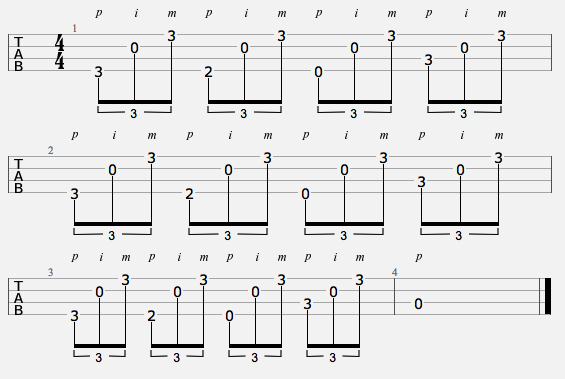
A simple pattern using each finger in order with the thumb starting on the g-string then moving to the C-string. Making a p i m p i m p i m… picking pattern.
Since you’re using three fingers, this pattern is well suited to playing in triplets.
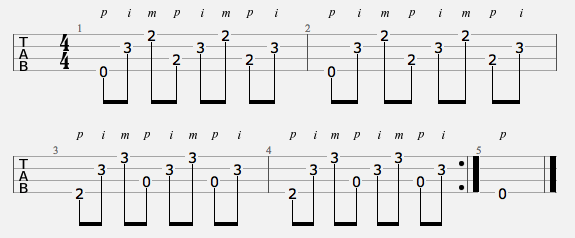
Complicated PIMP Pattern
A similar pattern to last time. But here you’re not using triplets so you have to fill out the bar with just the first two notes of the pattern. So you play p i m but just p i the final time.
Reverse Pattern
Rather than going up the strings as you did in the last two patterns here you pluck with the thumb then go down the strings. So it’s p m i repeated.
Alternate Picking
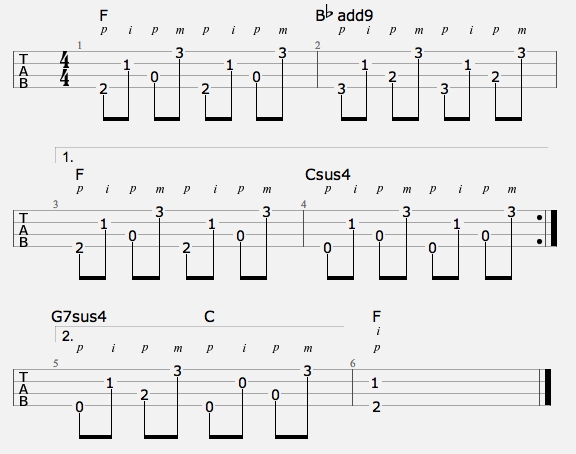
Alternating is my favourite way to use the thumb and two fingers method. Here the thumb alternates between the g- and C-strings.
In this particular pattern you pluck g-string with your thumb, E with middle, C-string with thumb, A with middle. So it’s p i p m.
One Finger Per String Picking
PIMA Pattern
Picking with your thumb and going up the strings to make p a m i.
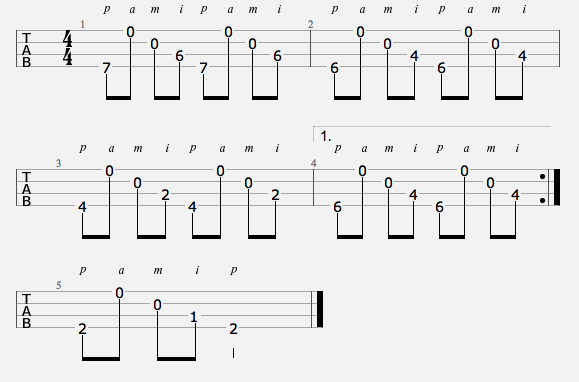
PAMI Pattern
Here you pluck the g-string with your thumb. Then go through the strings in the opposite direction. Making a p a m i pattern.
Choosing a Pattern
If you’re unsure of which method of picking to use for a pattern I have a general rule for choosing.
If the g- and C-strings are played next to each other at any point I go with the one finger per string method. It’s much easier than having to switch strings with your thumb quickly.
But if the g- and C-strings aren’t played consecutively then I’ll go with the thumb and two fingers method. I find it much easier to play in general.
Here’s a quick illustration. This is the first thumb and two fingers method played using the one finger person string method. If you’re anything like me you’ll find it trickier to play this way.