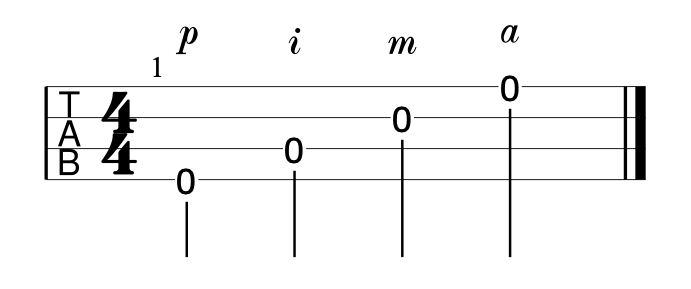
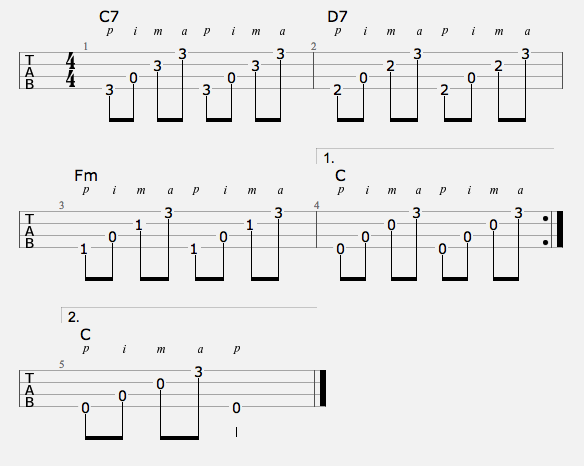
In ukulele tab the finger you use to pluck the note is indicated by a letter in italics above the tab. They look like this:
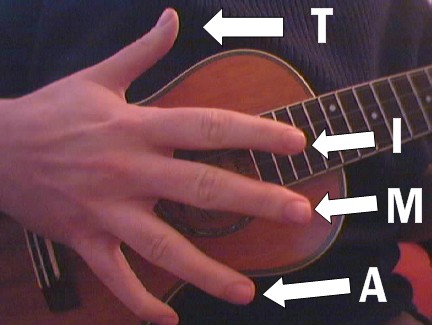
Each letter corresponds to a finger on your picking hand:
t or p = Thumb
i = Index Finger
m = Middle Finger
a = Ring Finger
So when a note has an i above it you pluck that string with your index finger.
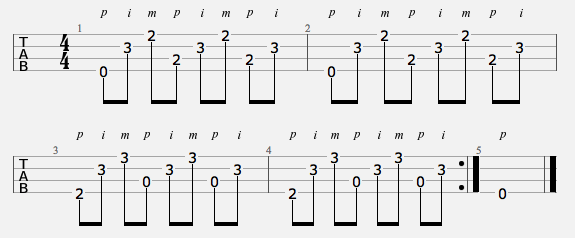
You won’t always find the picking notation. Sometimes you’ll just see it at the beginning of the piece and you just carry on that pattern all the way through. Sometimes you’ll just get the fingering for tricky sections.
The names are shortened from: pulgar, indice, medius, annular.
– You don’t use your ring finger. All the picking is done with thumb, index finger and middle finger. – The thumb plays notes on both the g- and C-strings.
So the fingers cover these strings:
Thumb: g- and C-strings. Index Finger: E-string. Middle finger: A-string.
This method of picking has a few advantages over
The big disadvantage is that it makes it harder to play patterns where the g- and C-stings are played next to each other in a pattern. So if you’re playing a pattern that has that use the One Finger Per String Method.
The One Finger Per String Method is the most logical way of arranging your picking hand. Each string is allocated a finger. Each string is only played with one finger and each finger only plays one string.
They are arranged:
Thumb – g-string
Index Finger – C string
Middle Finger – E string
Ring Finger – A string
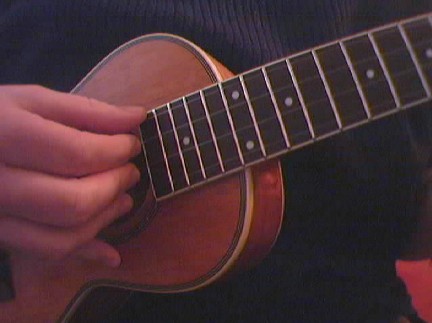
Like this:
As you can see, I use my little finger as an anchor. Don’t copy that! It’s a bad habit. This stabilizes the hand but there is a trade off. Letting you hand hover over the strings will give your fingers greater flexibility and make it easier to switch between picking and strumming.
And it means my hand always falls into that position. So whenever I’ve chugging a beer in a manly fashion I’m also raising a delicate pinkie.
Anyway, their performance inspired me to have a go at this instrumental piece. I first tried it on standard uke but it didn’t work out. I moved on to low-G with was better. Then I went insane and decided to drag my aNueNue harp ukulele out of deep storage.
Harp Ukulele
The harp strings on the uke are supposed to be tuned C, D, E, F. But I retuned the bottom two to A. One to pluck and the other to give a bit of sympathetic resonance. The sympathetic resonance turned out quite well. You can particularly hear the reverb-like effect at the beginning.
Important: The letters above the tab represent the bass note being played in that bar they’re not the chords.
Low-G
The strings tabbed are just tuned like a normal low-G. And it’s tabbed in the same key as the original. So if you’re playing a low-G you can just play this tab along with the record or a bass-playing friend.
Standard Tuning Version
To play it with a high-g ukulele you’ll need to move the whole thing up an octave. Here’s a tab for that. This time with the chord names above the tab.
Nype suggested I do a uke version of Eddie Vedder’s Tuolumne from the soundtrack of Into the Wild (and the precursor to Just Breathe). I was a bit trepedacious as a lot of guitar picking songs end up finger-crunchingly tricky on ukulele. But it actually works out very well. I didn’t even have to change the key.
Trickiest Bit
Moving down from the 10th fret at the end of bar 2 to the 3rd fret. If you have trouble with that you can take off that 10th fret and just play bar 2 like bar 3.
Picking Pattern
The right hand is doing a constant Travis-picking pattern. The thumb alternates between the g and C-strings, the index finger picks the E-string and the middle finger picks the A-string.
This is a fairly difficult one. Lots of barre chords, the dreaded E chord and some confusing rhythms. Still, none of it’s as tricky as spelling the title.
I was inspired by Ukulele Cat to knock up my own version of the Keyboard Cat tune. It’s dead simple, just the D and Dm chord shapes on the C, E and A strings. Make sure you’ve got the chord shape in place at the start of the bar and you’re good to go.
For the picking I’m using:
Thumb – C-string. Index – E-string. Middle – A-string.
I tried to stick to an alternating thumb pattern (moving between g and C). With index finger on E and middle on A. But the melody does sometimes stray onto the C-string which screws things up (such as the D in bar 4). Those notes I play with my index finger.
This is easily one of the best protest songs ever written. And one of the best songs of any sort. The lyrics are as nuanced and thought-provoking then any other. But it’s the music – written by Clive Langer – that really makes it shine.
The song is in the key of E minor but you’re hardly ever using the Em chord. In my arrangement there’s a grand total of three bars of it. So the song never feels relaxed or settled. It’s always shifting. The jazzy elements unsettle the tune. All that is added to in Robert Wyatt’s version with his vocal wobbles.
I could keep rambling on but I’ll let you play it.