I’ve had to come up with my own method of writing up strums both for the blog and for the How To Play Ukulele Strums ebook I’m working on. I’ve tried to keep it as simple as possible, and here’s what I’ve come up with:
d : indicates a down strum.
u : indicates an up strum.
– : indicates a pause or missed strum i.e. moving your hand either up or down but not hitting the strings.They are most useful to give you an indication of the timing of the strums.
x : indicates a chnk. Strumming down and following through so the underside of your hand lands on the strings creating a ‘chnk’ sound.
(d) or (u) : A muted down/up strum. Strumming as normal but with your fretting fingers resting on the strings to stop them ringing. It sounds like a chnk but you can do them with strums in either direction.
D or U : when in bold and/or capitalised that means the strum is emphasized (i.e. give it a bit more welly).
TTT : triplet strum. There are plenty of ways to do these. My personal favourite is down with middle and index fingers, up with index, up with middle. Here’s Jake discussing his preferred method. Or you could be a complete flash-Harry and use a fan stroke.
Ukulele Strumming in Tabs
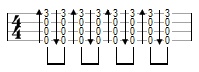
You’ll also see strums written up in tab form. Here an up arrow indicates a down strum and a down arrow indicates an up strum. (Make sense? Good.)
So a down, up, down, up… strum looks like this.
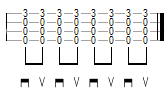
A less common method – but quite a neat one – is to use guitar pick direction tab for strum directions.
A down strum looks like this:

And an up strum looks like this:

So a down, up, down, up… strum would look like this:
If you want to learn more about the subject, take a look at my ebook on Ukulele Strumming



Those seem fairly clear. Not sure that guitar notation is particularly intuitive but i’m sure one gets used to it. For the d u type notation I found that the way they do it on this cheat sheet easy to follow:
http://www.ukemaker.com/ukeclub/media/StrumPatterns.pdf
It’s pretty simple to follow. The boxes keep it clear where you are in the measure. Then capital U or D for emphasized beats.