A genre hopping week this week with soul from Celisse Henderson, backwoods punk from the Denver City Saltlicks (and check out their badass diddley bow riffing) and reggae from Tribal Theory along with the usual bits of instrumental wizardry and girls with jazzy voices.
New live album from the UOGB on the way: Still Live. Tracks include new tour hits like Hot Lips and Good Sculptures and new versions of old favourites like Le Freak and Monster. Full track list on UOGB Frog Fans.
The Hitachi Ukulele contest shambles I mentioned last week is rolling on. After complaints from schools they will look at the sites sending traffic and, “if we deem those sites to be inappropriate or unacceptable within the spirit of the competition then they will be disqualified.” I’m not sure how people are supposed to control which sites link to them. Or if it’s legal to change contest rules after they’ve finished in Australia.
It’s the big day tomorrow. Prince William finally makes Ken Middleton his bride. He’s always been royalty in our eyes.
As luck would have it, the Cabral machete method that I’ve been covering has two tunes appropriate to the occasion (read Part 1 and Part 2 of the series if you’ve no idea what I’m on about). Quite why a Madeiran machete method would dedicate two tunes to UK anthems I’m not sure.
Both these pieces are written for machete tuning DGBD (an octave above the baritone and with a low-D string and the E-string tuned down to D). But both of them sound great played with a standard ukulele with the A-string tuned down to G (so it’s the same pitch as the g-string).
God Save the Queen
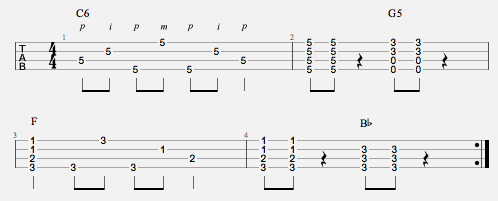
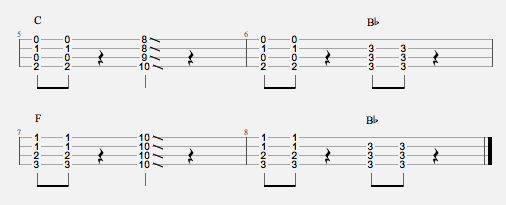
God Save the Queen (Tab)
As an atheist, republican with no desire to crush the Scottish, I have problems with this being the national anthem. I’d much prefer a song with a sentiment everyone can get behind like this one.
One thing I’m unsure of in this tab: the second chord in bar 3. I’m pretty sure I’ve written it up correctly but it sounds very discordant. Even more so in re-entrant tuning. Play it with an, “I know it sounds like shit and I don’t care,” attitude and you’ll get away with it (or pretty much anything).
In Manuel Morais‘s Colecção de Peças para Machete (well worth buying if you’re interested in this stuff) he says that an open bracket shape in the standard notation indicates that the chord is strummed down with the thumb. Which is the way I’ve written it up. But I didn’t play it that way. To play bar 16 that way is going to require some very nifty thumb work. Instead I went the easy way and used my fingers to pluck all the notes. Not authentic, but neither is playing it on a ukulele. Here’s the result:
In what was intended to be a very straight-forward tab for Crazy, I couldn’t resist throwing in a few bent notes in bar 21. I’ve had a couple of people struggle with it so I thought I’d put up a brief post about bending.
The Basic Idea
You bend a string by pushing it upwards (for the E- and A-strings) or pulling it down (g and C) whilst staying at the same fret. This raises the pitch of the note. It looks like this:
Technically, you should bend the note up one fret’s worth where the tab has ‘1/2’ at the top and two frets worth where there is a ‘1’. However, nylon strings don’t take to bend as kindly as steel strings so you’re doing very well if you can accurately get a two step bend. I usually use bends on the uke to transition smoothly between two notes. Using it like a slide except it allows for a slower and more smooth transition.
A Couple of Tips
Finger Support: Use your ring finger to bend have your middle and index fingers behind it so you get extra bending power. In the example above, I needed my index finger to play the next note so I’m only using my middle as back-up.
Thumb Positioning: Bring your thumb over the top of the neck. That gives you much more squeezing power and it can also be used to stop the g- and C-strings from sounding – which they can do as your bend will rub up against them.
This video made both me and L.bo Marie cry. She because the music is so affecting. Me because comparing their fresh-faces to my craggy, careworn flesh reminded me that my death is but a blink away.
Two things to bear in mind before you set out on this one. Firstly, he’s tuned down half a step to f# B Eb Ab. Secondly, I’ve simplified some of the chord names in the sheet. Technically the Em11 is Emadd11 and the F#m is F#maddb9.
Suggested Strumming
In the verses you can just do all down strums. That’s sixteen down strums for each chord (best to think of them as two groups of 8). If you want to follow what he does, he adds in a quick up-strum between the last two down-strums of each set of sixteen. So for each chord you’re doing this:
d – d – d – d – d – d – d – d –
d – d – d – d – d – d – d u d –
If you’re not doing the twiddly bit in the chorus you can continue with the down strums. Just be aware that it’s 8 then 6 down strums (not 8 then 8). So you’re doing this:
d – d – d – d – d – d – d – d –
d – d – d – d – d – d –
Twiddly Bits
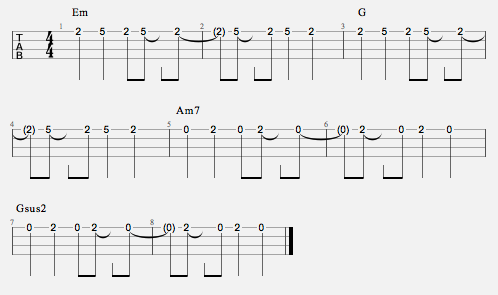
The guitar part that’s played in the verse fits on the uke like this:
The fancy bit in the chorus (shown at the bottom of the chord sheet) pretty much combines that with the chords.
A big, fat happy half-century to Phredd for his birthday on Monday. In celebration, him and his buddies playing 42 Monkeys.
Also this week: woodland indie-folk from We Aeronauts, NSFW language from Garfunkel and Oates, some Whokulele silliness from Jo Stephenson, the new one from Sophie Madeleine and the Sophie Madeleines and plenty more.
New rule: I’m allowed to post one video a week that has a uke-related instrument in without having to apologise or explain. This week: Brazilians Sangue Brasileiro.
Some very sad news on the ukulele sales front, musicguymic has had to shut up shop due to illness. Musicguymic was always the first person I recommended when it came to uke buying. I’ve never heard a word against the guy and he had the best selection and knowledge around. He’s really going to be missed and I wish him a speedy recovery.
The Eleuke electric acoustics are out. Eleukes have never been the prettiest ukuleles around but these really are an ugly piece of ass. Ukeku has a review (I don’t know how he could have given it 4/5 for looks).
Roper concert sized guitalele. Unusual to have a guitalele that small.
James Hill has a new book out: Great Popular Songs. It contains chords and standard notation for songs like Sister Kate, Midnight Special and Roving Gambler in high-g friendly format. You can get a free sample here.
I’ve been grumbling about the over-supply of ukulele contests for a while but the Hitachi heat pumps thing going on at the moment is by far the most irritating of all time. Everyone has to record their awful jingle and the winner is the video with the most views. With a $10,000 prize, lots of schools have entered and people have badgered me to feature their videos. But the inevitable winner is the one willing to show the most tit. I’m never buying anything made by Hitachi again. Except maybe one of these – after that video I have a stiff, erm, neck?
Tab-u-learn/Tri-Tabs has moved again. It’s now PDF Minstrel.
Zach ‘Scrubs’ Braff’s new play contains the role of Kim who, “Does not see how being an “escort” might not be the best path to becoming an internationally famous, ukulele-playing pop-star.” We’ve all been down that road.
You should be absolutely amazed that I’ve posted anything the last few days. This week has seen the two releases I’ve been looking forward to most this year: Portal 2 and the new tUnE-yArDs album. Both of which I’ve enjoyed even more than their predecessors.
Jonathan Coulton has written a new song for the game and if – like the first game – if it’s a ukulele song you can be sure it’ll turn up here. But I don’t want to ruin it by searching out the song before I finish the game, so here’s the standout ukulele-heavy track from W H O K I L L.
tUnInG-yArDs
She’s playing a tenor but actually has it tuned dGBE (like a baritone but with a high-D string).
rIfF 1
The song is mostly made up of two riffs. The first uses both fingerpicking and strums. For the picking use the thumb on the bottom two strings (d and G), index on the second string and middle on the first string.
rIfF 2
The second riff is all strums with a couple of slides thrown in:
sTaNdArD tUnInG
tUnE-yArDs – Powa (Standard tuning)(Tab)
The song transfers pretty well to standard tuning (whilst keeping it in the same key). The one note I’m not entirely happy with is the open A string in bar 3. It’s an octave above what’s being played in the original and I don’t think it’s quite right. One alternative would be to play the open C-string instead. Or, since she leaves out this note late in the song, don’t play anything at all.
Vibrato is making the note quiver by varying the pitch slightly. You hear it a lot in the big diva singers. They’ll hold a long, high note then make it wobble. Rather than singing the note straight they glide between singing slightly higher than the note to slightly lower than it. Recreating that effect on an instrument gives it a more expressive, human feel. One you’ll hear all the time in blues guitar solos. If you’re wanting to do any solo work on the ukulele, it’s well worth learning a couple of vibrato techniques.
Classical Style
Players of classical string instruments like cello and violin will create vibrato by moving back and forth slightly along the string – making the pitch go from slightly higher than the note to slightly lower than the note just like the vocal vibrato. It works very well on fretless instruments, but is also used on classical guitar and ukulele.
You do it by rocking your finger back and forth with the fret. Here’s the technique done slowly then more rapidly.
There are plenty of advantages to playing vibrato this way. It’s very suited to the uke’s nylon strings, it’s a subtle effect and it can be done with full chords like this:
Guitar Style
In guitar playing, vibrato is created by bending and releasing the string. You do it by pulling the string down (for the C-string – as in the video – or the g-string) or pushing it up (E- and A-strings). Here it is slow then fast:
This technique isn’t quite so friendly with the nylon strings. It creates a bit more noise. On the upside, you can get a much wider and wilder vibrato with it by doing larger bends more quickly. It’s also the ideal vibrato to use on bends like this:
When to Use Vibrato
Don’t go too overboard with the vibrato. Like most techniques, it’s most effective when you use it sparingly. The best place to bust it out is on the long notes at the end of a phrase. Also vary the speed and, with the guitar-style vibrato, width of the vibrato. You can do that even on one note. Try starting with a slow vibrato then speeding it up as the note fades.