Ukulele Scales Part 1: Major Scale

When I did my ukulele scales posts there were a few people who didn’t have a clue what it was all about. So, I thought I’d go back to basics and cover it from there.

The most common scale in all music is the major scale. You’ll hear it all over the place (pretty much every nursery rhyme, Christmas carol and national anthem uses it) and it’s the basis of all chords.

The major scale creates a particular pattern on the ukulele. This pattern can be moved up and down the neck depending on which key you play in.

C Major Scale

The most important note to concentrate on is the root note – the first one played and the last one played. For example, The C major scale starts on the open C string and ends on the A string, third fret. The pattern looks like this on the fretboard:

ukulele scale C

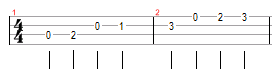
The tab looks like this:

C major ukulele scale tab

And sounds like this:


There are lots of ways you can use the major scale. One is for improvising a solo. In the following snippet, I’m improvising a little melody with the chords C, F and G and using only notes in the major scale pattern.


D Major Scale

For the D major scale, you use exactly the same pattern but start on a D note (C string second fret) and end on a D note (A string, fifth fret). Giving you this:
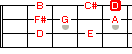
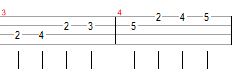
ukulele d scale tab

d major ukulele scale tab


F Major Scale

Moving that pattern up and down the fretboard will give you a major scale wherever you use it. Whichever key you want to play the major scale in, find that note on the C string and start the pattern from there.

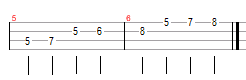
For example, to get the F major scale, you start the scale pattern on the fifth fret of the c string which gives you this pattern:
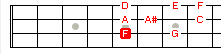
ukulele scale f major tab

This tab:

f major scale ukulele tab

And sounds like this:


22 Comments

  1. Jon June 25th, 2008 6:16 pm

    Thanks, I was one of the people who expressed confusion.

  2. Woodshed June 25th, 2008 10:16 pm

    I hope it made more sense this time, Jon.

  3. Jon June 26th, 2008 5:18 am

    Yeah, it did. I’ve got two weeks off coming up shortly. I intend to devote the time to intensive practice. I haven’t had any time to learn anything new in months. I have just enough practice time to keep up my chops on the stuff I already know. By the way, I wrote something in defense of Julia Nunes that, on sober reflection, sounded slightly hostile. Let me make it clear that this site is fabulous and you are a great person. I’ve bought two of your e books and saved all of your finger picking emails, That’s what I’ll be studying on my vacation. I love learning new stuff on the ukulele, I just want to keep it silly.

  4. rilrod June 26th, 2008 7:26 am

    I was also one of the few who expressed confusion. You’ll be pleased to hear that I completely understand now. Keep up the great work on the site.

    Ukuleles Represent

  5. lillibit June 26th, 2008 6:08 pm

    Thanks! Ii was very confused with the other scales, I need see the tabs with numbers.

  6. Woodshed June 26th, 2008 10:45 pm

    Jon: Don’t worry about it. No offence taken. Have fun with your ukulele holiday.

    rilrod: Glad it helped.

    lillibit: Yeah, I like tabs, too. But some people prefer to see a fretboard layout.

  7. Evan June 20th, 2009 12:12 am

    so how come from the d scale to the f scale it went up 3 frets and not 4? i figured 2 frets to E scale and 2 frets to F scales

  8. Ryan June 20th, 2009 6:08 pm

    E to F is a half step

  9. Woodshed June 21st, 2009 8:51 pm

    Evan: Ryan is spot on. F is only one fret up from from E.

  10. Zuke February 4th, 2010 10:13 am

    Very useful – thanks!

    I’m just beginning to explore tabs after learning a few chords, what are the grey circles and semi circles in your tabs?

  11. Dave April 9th, 2010 7:58 pm

    This was a huge help, really appreciate you breaking it down even further for us all to understand.

  12. Woodshed April 11th, 2010 2:20 pm

    Zuke: I’m not sure what you’re referring to with the grey circles. Could you like to one with it on?

    Dave: Glad you found it useful.

  13. Levi April 23rd, 2010 3:40 am

    Zuke, those grey circles are the markings on the fretboard. They are great for easy reference points.

  14. Woodshed May 3rd, 2010 2:15 pm

    Levi: Thanks for clearing that up.

  15. Laurah Jean November 5th, 2010 9:50 am

    Ahahahah! After staring at the fretboard layouts for like an hour, i finally understand! (I already understood the patterns/progressions from clarinet and piano theory, but thought someone had been toking up or something before creating the fretboard patterns) I feel remarkably stupid, and thoroughly enlightened, all at the same time C:

  16. Woodshed November 6th, 2010 4:06 pm

    Laurah Jean: Glad you figured it out eventually. I’m still trying to come up with a better way of presenting this sort of thing.

  17. Vlad Levitt December 4th, 2010 3:44 am

    I as well was one of the confused people, but that post very easily cleared everything up. Thank you very much!

  18. Woodshed December 5th, 2010 5:06 pm

    Vlad: Glad it made sense to you.

  19. SteveG January 14th, 2011 6:18 pm

    SO correct me if I’m wrong this major scale ‘pattern’ once learned is portable? …that is it will work anywhere up or down the fretboard on the CEA strings …right? Kewl!!

  20. Woodshed January 16th, 2011 10:38 am

    Steve: Absolutely correct.

  21. Kate April 22nd, 2012 8:31 am

    Was going to finish my university application today but instead got sidetracked by this blog. Love it, thanks!

  22. Woodshed April 22nd, 2012 11:17 pm

    Kate: You made the right choice!

Got something to say?