Every so often I take a look at the site analytics and the pile of rejected requests to find out what people are turning up on the site looking for and leaving unfulfilled. The answer is usually very depressing. And very dangerous. The last time I caved in to pressure ended up with me in hospital.
So this time I’m resisting requests for that damn Train song. Instead I’ll go with the second most searched for: the chords for Happy Birthday.
Suggested Strumming
All down strums. Simple. The only slightly unusual thing is that it’s in 3/4 time. That means the down strums are in groups of 3 rather than, the more common, groups of 4.
Twiddly Bits
The tab I did of Happy Birthday before but it was far too jazzy (and too crap). So I’ve put together a simple one that’s easy to do at a family occasion.
If you’ve been following my fingerstyle arrangements for a while you’ll have noticed – and probably been frustrated by – how much jumping between strings goes on. It’s certainly not the easiest ways to arrange tunes but it’s very effective and gives the uke a harp-like sound of close harmony notes ringing into each other.
What is Campenella?
The campenella technique was developed for the ukulele by John King who took long forgotten techniques for playing re-entrant instruments and gave them new life. In this style of playing you play one note of the melody on each string and let them ring into each other.
If you can avoid it, you never play two consecutive notes on the same string.
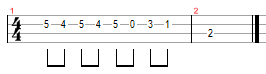
Here’s a standard way of playing a melody:
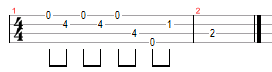
And here’s how you could play it campanellla style:
To get the full effect, it’s vital that you let the notes ring together. So you want to have your fretting hand moving as little as possible – holding chord shapes rather than playing single notes – and have your picking hand doing most of the work.
Why Play This Way?
The harp is my absolute favourite instrument (take a listen to Savourna Stevenson). If I had been richer and not so lazy as a kid you’d reading an article on Harp Hunt about how to make your harp sound like a ukulele.
I love to recreate that sound of notes cascading into each other on the uke.
It also creates a sound that is unique to the ukulele. Of course a uke is never going to sound like a harp. Playing single notes on the uke can often just sound like a guitar played high up the neck. Whereas the campanella sound couldn’t be achieved recreated quite the same on any other instrument.
How Do You Arrange This Way?
The way I do it is trial and error. When you play this way there are any number of different ways a simple line could be played.
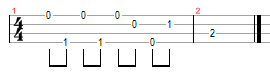
The example we looked at earlier could also be played like this:
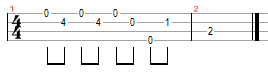
Or like this:
Finding the right one depends on a combination of playability, fluidity and note emphasis.
It’s also well worth keeping an eye out for open strings you could use. These will give you an opportunity to change positions whilst keeping a note ringing.
I’m going to a quarter break by no-Beatles rule today and post Paul McCartney’s ukulele tune. The original has some very dodgy tuning in it, but Greg Hawkes’s cover makes it much more obvious what a nice little tune it is.
I’ve put up the tabs but you can just play the chords without missing out on too much.
On my wanders around the net I stumbled across a few mp3s from the former band of, Katzenjammer ukestress, Marianne Sveen (and, no, I wasn’t looking for compromising pictures and any server logs you find that suggest otherwise are forged). They’re not quite as genre-hopping as the Katzenjammer stuff but display what an incredible voice she has. Makes you wonder why the other ones in the band get a look in.
Charlie McDonnell – Exterminate, Regenerate (Chords)
My post on the adorable Charlie ‘charlieissocoollike’ McDonnell’s A Song About Acne proved very popular, so I thought I’d follow it up with his latest tune despite the fact I don’t understand a single reference in it. I’ve only watched two episodes of Dr Who (one set in Rome and one with Peter Kay in) and they were both unremittingly dreadful. I didn’t even get that it was a song about Dr Who until he explained it at the end. Turns out I fail at video games as well.
The chords aren’t the standard fare – there’s not an open string in the whole tune.
Suggested Strumming
For the intro:
d – d – x u – u
– u – u – u d –
The verse starts with some single strums then doubles up the tempo with this strumming pattern twice for most of the chords but once each in the E – F# move.
Turning the brilliant up to 11 this week are Sigur Ros’s Jónsi (thanks to Fivetide who drew my attention to his performance
on Lauren Laverne’s radio show last week at about 1hr44), Allo Darlin’ quoting El Scorcho at a band-bigger-than-the-crowd show as SXSW, Tricity Vogue with one of her handsome young men, Thos Henley and a selection of familiar faces. Read the rest of this entry »
No competition for the uke I want most this week. The Juke-a-lele is the latest addition to KoAloha’s Masterpiece series. Not as classic a design as the Sceptre, but that’s not going to stop me wanting one.
I’m not much of a banjolele fan, but I could go for one that looks as good as this Ludwig Wendell Hall.
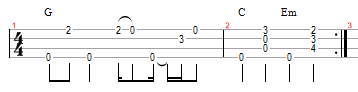
This lovely tune from the Keston Cobblers’ Club got a great reaction when I featured it on the UkeTube. And Matt from the band was kind enough to share the chords and lyrics so I thought I’d write them up.
Suggested Strumming
For the most part it’s just down strums with a ‘d u d u’ just before the chord changes.
So in the first part the G would be:
d – d – d – d –
d – d – d u d u
And the C and E:
d – d – d u d u
The exception is the C in lines three and four where you just need two down strums.
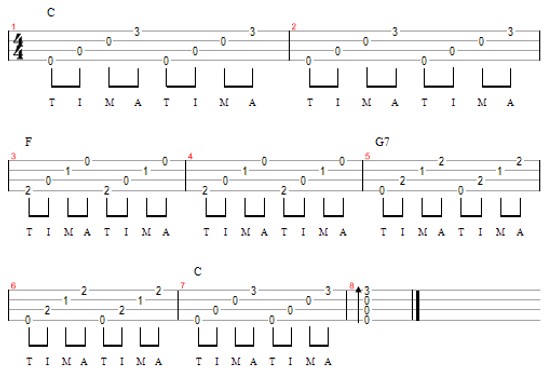
Back in the olden days I had a fingerpicking mini-course available for people who signed up for my mailing list. It’s been unavailable for quite a while and a few people have been asking about it. So here’s the first part of it and the rest of it will be available once I work out what I want to do with it.
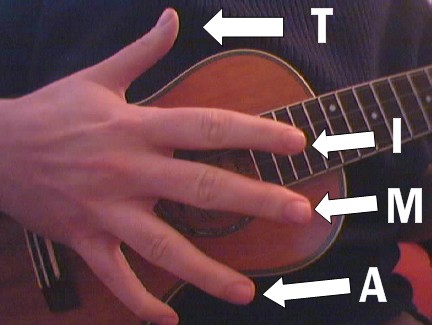
In order to tab fingerpicking, we need to introduce some new notation. The fingers of the picking hand are referred to as:
T = Thumb
I = Index Finger
M = Middle Finger
A = Ring Finger
The finger names come from pulgar, indice, medius, annular.
Each of these fingers is allocated to an individual string:
Thumb – g-string
Index Finger – C string
Middle Finger – E string
Ring Finger – A string
Like this:
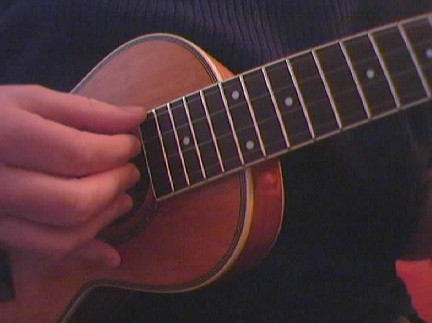
As you can see, I use my little finger as an anchor. This stabilizes the hand. However, there is a trade off. Letting you hand hover over the strings will give your fingers greater flexibility and make it easier to switch between picking and strumming.
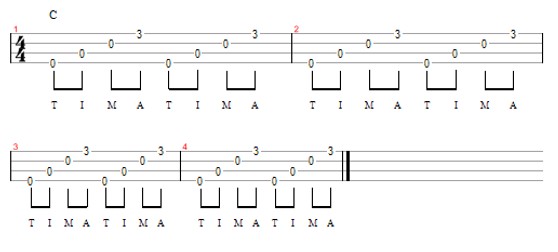
Once you’ve got comfortable with that position, try this simple exercise.
Here, we’re picking through the each string in order while holding down a C chord. When picking a note, your fingertip should be very slightly underneath the string. You pluck it by bringing your finger up and towards your head (or up and away from you head for your thumb).
Make sure you let all the notes ring into each other so that, by the time you’ve picked all the notes, a full chord is ringing.
You can see a video (mpg) of me doing this (first slowly then sped up) here:
Once you get the hang of this, you can try changing chords while playing it. Like this:
Example 2
This can feel like trying to rub your stomach and pat your head at the same time. But a little bit of practice and it start to come more naturally.