I’m going to get so much comment spam on this post.
Since I tabbed out Scotland the Brave for Burns Night (I’ve updated that post with a longer tab), I thought I’d also do an actual Burns song. Cock Up Your Beaver is, apparently, a call to raise your hat. I’m a little skeptical as to whether there’s no pun intended. Particularly after reading the lyrics to songs like this one and those in the pdf on this page.
Whatever the truth, the song is popular with a modern audience. The version of the song in the player is the one played by Camera Obscura for a Burns Night Peel session in 2004.
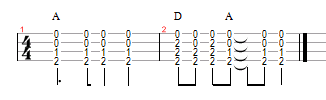
The chords are dead simple – just A and D – leaving you plenty of brain space to concentrate on keeping a straight face. If you want to fancy it up a bit, you can play this to ape the guitar part:
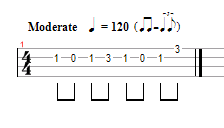
After playing Whack-A-Haggis for far longer than any sane man should, I decided to work out the tune: The Sons of Eilean Donan by Gayle Ellett. Here’s a rough tab of the melody.
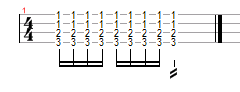
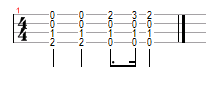
Strumming the same chord over-and-over in a regular, quick tempo is known as a tremelo strum. These can be tabbed in a couple of different ways. They can be shown in the normal way (e.g. as a set of sixteenth notes) or as the total length of all the strums together with diagonal lines underneath the note.
In this example, the first half of the bar and the second half are both played in exactly the same way. One diagonal line under the note indicates eighth notes, two lines denotes sixteenth notes and so on.
Rasgueados
Rasgueados, sometimes called rolls, are a technique that entered ukulele playing via its Portuguese roots – developing from flamenco playing.
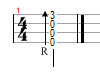
They are produced by strumming with each finger in quick succession. You start by flicking downwards with your little finger, then ring, then middle and finally index finger. It’s important that the movement comes from the fingers rather than the wrist so you can hear each individual strum. In the example, I play through slowly (so the strums are very distinct) then up to speed.
You can learn the proper, flamenco technique from this guy’s videos.
Rasgueados are tabbed in a very similar way to usual strums. The only difference is an ‘R’ at the base of the strum.
Advanced Rhythm Tab
Dotted Notes
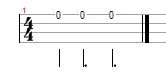
Often in tab you’ll see dots after the note lengths.
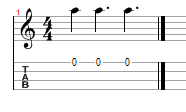
In standard notation these dots occur next to the circle of the note:
In tab, the dots occur next to the bottom of the line (you have to be careful as dotted quarter notes can be easily confused with eighth notes).
These dots increase the length of the note by half. For example, a dot after a half note would increase its length by quarter note i.e. it would last for three beats.
In example 9 it is a quarter note which is dotted. This means it last for a quarter note plus an eighth note.
Ties
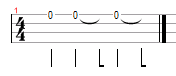
When notes are tied together you add their lengths together. The tab for ties is an arch between the notes – the same as hammer-ons but in this case there is no note at the end of the arch.
For instance, the dotted note examples could be written with ties to create this:
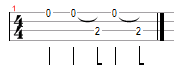
Often ties will be used to show one note ringing into another.
In this example, the open A string is left ringing while the C string is played. Quite often notes will be intended to ring into each other but there will not ties in the tablature. In this case, you should listen to the performance and decide what you think sounds best.
Triplets
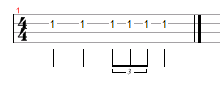
With triplets, three notes are played in the space of two.
They are indicated by a bracket under the notes with a 3 in the middle.
You can have any length of note in a triplet, but in this example it’s eighth notes.
A triplet of eighth notes takes up the same amount of time as two regular eighth notes i.e. one ‘pip’ in the example.
Make sure that your triplets are evenly spaced within the time.
Swing Time
When a piece has a triplet feel throughout, it is said to be in ‘swing time’. Swing time can be heard in musical styles from blues to Irish folk music to reggae. In swing time, the first half of each pair of eighth notes is played for longer than the second eighth note of the pair.
Swing time is indicated at the top left of the tab like this:
Compare this example in swing time:
To this one in straight time:
Swing time changes the length of eighth notes. The first in a pair of eighth notes now takes up the amount of time of two eighth notes in a triplet. The second eighth note in each pair now only takes up one triplet eighth note.
The technical explanation of this makes it sound more complicated to play than it is. Once you get the feel of a song, it becomes natural to play it and you’ll be able to do it without thinking about it..
.
Read the rest of the series here: How to Read Ukulele Tab.
It’s Burns Night on Friday and Andy (who you might know as zym if you’ve been following the comments) requested a tab of Scotland the Brave for his Burns night turn.
When I was researching the song (believe it or not, I do research), I found out the song is a lot more modern than I had thought. The melody first appeared around the start of the 20th Century and the lyrics were written in 1951. Speaking of which, these have to be some of most unlikely lyrics ever written:
Far off in sunlit places,
Sad are the Scottish faces,
Yearning to feel the kiss
Of sweet Scottish rain.
I’ve kept the arrangement very simple to give Andy a chance of getting down by Friday (and being able to play if after a drop or two). It’s simply the melody accompanied by occasional chord strums (C, F and G). Let the chords and notes ring for as long as possible to give it a bit more body.
If you’d like to recreate the sound of the bagpipes for this tune, get yourself a wheezing cow with a kazoo stuck down its throat to accompany you.
If you’ve been hanging around the online ukulele community for any length of time, you’ll have come across Howlin’ Hobbit. He’s one of the biggest ukulele proselytizers around and a ukulele style guru.
As well as busking at Seattle’s Pike Place Market and going on a long, boring quest for a ring, Hobbit plays uke (and occasionally other instruments) with Snake Suspenderz. The group was originally a duo with, tromboner, Thaddeus Spae, and has now grown to a quartet. They make witty, catchy hokum music and have just released a new CD A Few Loose Scales.
Hazlehurst’s theme tune for Last of the Summer Wineis the sound of death to me. The show follows three pensioners as they shuffle around the Yorkshire Dales doing nothing much in particular. It has been shown on the BBC every Sunday evening for the last 300 years. Because of this (and because Hazlehurst did a great job with the tune) the opening credits of Last of the Summer Wine always give me that little-death feeling you get on a Sunday night (and not the sexy French kind) before you have to go back to the grind on a Monday morning.
Thanks to the crawling pace, it’s simple to play. Most of the notes are open or part of the chords (F, Bb, C and Gm). There’s a trip up to the Gm at the fifth fret, but other than that it’s plain sailing.
Jonathan Coulton/Sweetafton – Tom Cruise Crazy (Chords)
Thanks everyone who voted. After a nice, round 200 votes, the winner was Sweetafton23’s cover of Jonathan Coulton‘s Tom Cruise Crazy. A very deserving winner (although if Willa had picked up that uke in her version of Re: Your Brains it might have been another story) and very topical. If you enjoyed TCC, watch MyHope – her own song with some definite Coulton influence.
The chords for this version are a little different from the original. The most obvious difference being the ukulele version is in the key of A rather than E. There’s also this nifty little bit that crops up in the intro and at the end of the chorus.
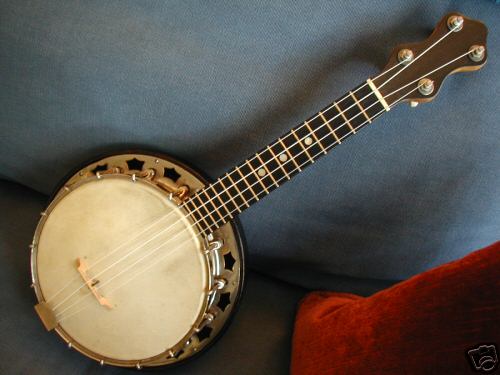
The most head-turning uke on eBay at the moment is this 1930’s Abbott Monarchbanjo ukulele. It’s pretty much identical to the one made for George Formby and was part of the near mythical Akira Tsumura collection (I’m going to throw a few allegedlies in at this point just to be safe: allegedly, allegedly). Tsumura made his millions selling Kampo medicine and spent a fair wedge of it collecting guitars, banjos and the occasional ukulele. His collection was so valuable, a book of pictures of his banjos sells for $1,250. Unsurprisingly, you’ll need deep pockets if you want this banjo-uke. The last time it came up for auction, bids went as high as $7,500 and it didn’t trouble the reserve.
I’ve never been a fan of the pineapple ukulele shape. They don’t have the same elegance as the standard shape. But one pineapple uke you could never accuse of being inelegant is the KoAloha Pineapple Sunday. The uke is the first of KoAloha’s seven part Masterpiece Signature Series. The $1,500 price tag is worth it just for the grinning photo of Alvin Okami, but if your budget is more limited you could try the standard KoAloha pineapple (but then your back to the inelegant problem).
If you’ve still got some pocket money left after those two, maybe you should fill out your collection with this Custom Moore Bettah ukulele by Chuck Moore.
The chords for Lips Are Unhappy fit nicely on the ukulele. In the chord chart I’ve written the C chord as the Bb chord shape (but 2 frets higher). I think this inversion sounds better and it means you can slide up to it from the Bb. But you can use the standard C shape if you prefer.
One thing to notice about the chords is the C6 that crops up. It’s in brackets in the intro because it’s a passing chord – you only strum it once. It’s only there briefly but, since all the strings are strummed open, it’s not difficult to play.
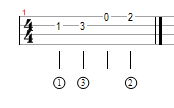
When the fingering of a certain passage is important, tab will give a guide as to which fingers should be used both for fretting and picking.
Fretting Hand
The fretting hand (the left hand for right-handed players) is indicated by numbers in circles underneath the tab.
The index finger is 1, middle finger 2 etc. When strings are played open, no finger is indicated.
Picking Hand
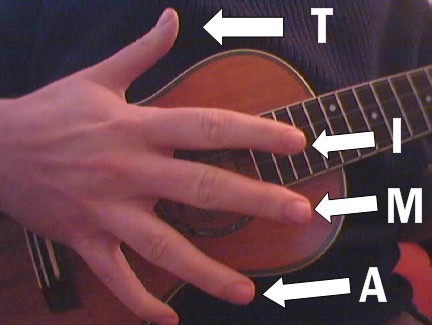
The tab for the picking hand is less intuitive.
T = Thumb
I = Index Finger
M = Middle Finger
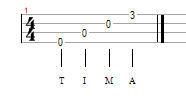
A = Ring Finger
The finger names come, apparently, from Latin (indice, medius, annular).
These letters appear under the tab also.
Repeats
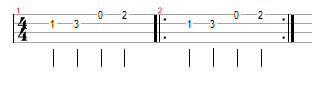
There are a number of ways that repeats are shown in tabs. The main way is with a set of double bar lines (one thick and one thin) and two dots.
When you come across a set of these with the dots facing right, you skip straight past them. When the dots are facing left, you go back to the first set (where the dots are facing right) and play through again. The second time you reach the repeat sign, play straight through it unless it indicates otherwise (by say x3, x4 etc.).
In this example, you play bar one and bar two, then bar two again.
If there is no first set of repeat signs, go back to the beginning and play through again.
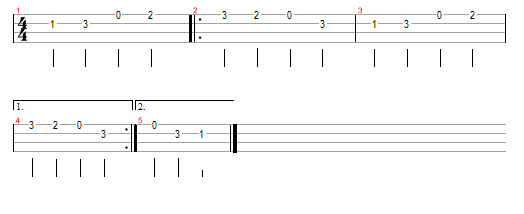
Sometimes you’ll see sections at the end of each repeat blocked off like this:
Here you play the bar underneath the 1 section the first time round, follow the repeat sign as normal, then second time round you skip that bar and play the bar underneath the 2 instead.
So, you’d play bars:
1, 2, 3, 4, 2, 3, 5
The section under the 1 can be any number of bars – the idea remains the same.
You can also have any number of alternate bars. If the section is repeated 4 times, there may be 4 different endings written. You just play these in sequence the same way..
.
Read the rest of the series here: How to Read Ukulele Tab.