There are a few variations in how chord charts are shown. But, since they’re a fairly intuitive picture of what to do, it’s not hard to work out.
The Dots
The type of chord chart I use shows the ukulele fretboard as if it’s pointing upwards and facing towards you. The strings are the vertical lines (starting with G at the left) and the horizontal lines are the frets.
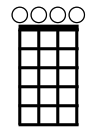
Chord shapes are shown by dots at where each finger should go.
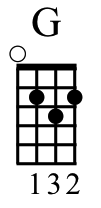
For this G chord, you play the C string at the second fret, the E string at the third fret and the A string at the second fret. Wherever there is a ‘o’ at the top of the string, that means the string is played open (it is not fretted at all).
The Numbers
The numbers at the bottom refer to the finger that you use rather than the fret. So a 1 would mean you fret that string using your index/pointer finger, a 2 would mean you use your middle finger and so on. It’s important to remember that the refer to fingers not strings (often they’re the same so it can be confusing).
For example, the G chord. You fret the A string at the second fret with your second finger, the E string at the third fret with your third finger and the C string at the second fret with your first finger.
These fingerings are just suggestions. If there’s another way of arranging your fingers, that’s not a problem.
Some, such as this ukulele chord chart, show the fingerings within the dots themselves.
Xs
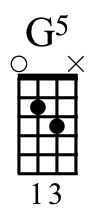
You’ll sometimes see an ‘X’ at the top of the string. This means the string is not played at all. You might need to rest one of your fretting hand fingers against the string (without actually fretting it) to make sure it doesn’t sound.
Barre Chords
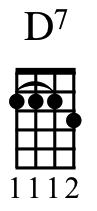
Barre chords, i.e. where one finger plays more than one string, can be represented by an arch over the barred strings (below) or with a black bar stretching across the strings (like this).
Chords Up the Neck
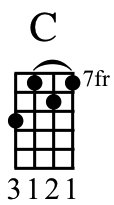
When a chord is played higher up the fretboard, the lowest fret played is indicated at the top right (sometimes it’s on the left). In this example, the C and A strings are played at the seventh fret, the E string at the eighth fret and the G string at the ninth fret.
Text Chords
Sometimes, when I want to refer to chord shapes quickly, I just use four numbers like this 2100. These refer to the fret numbers for each string in the order gCEA. So the 2 means you play the g-string at the second fret, the 1 means you play the C-string at the first fret and the 0s mean you play the E and A-strings open. Giving you the standard A chord shape.



You know, I would pay good money for a decent ukulele chord chart/booklet.
I tend to find songs/chords on Guitar sites, so would love something that had all the sus4s ,sus2s, dim5ths, 9ths, slash chords, etc
I would also like something that was small enough to fit in my case (maybe A5 size)
(oh, and the moon on a stick)