Reading Sheet Music for the Ukulele

Compared to tabs, reading standard notation is a complete pain in the arse. For some reason, there are a few ukulele books that use only standard notation (such as the Jumpin’ Jim books and some of the Ukulele Masters series). I thought I’d knock together a short post in the hope of making all those squiggles and splatters a little more decipherable.

There are certain similarities with tab such as rhythms and repeats (there’s a full guide to reading ukulele tab here). So I’m just going over how musical notation indicates pitch.

Like tab, there are a bunch of horizontal lines (known as a stave), but that’s where the similarity ends. Notes are indicated by the position of the dots: the higher up the stave a dot is, the higher the note. The dots can appear on the lines or between them. Each time you shift up a position, you go up to the next white key on the piano (C,D,E,F,G,A,B etc.)

Here are the notes as they compare to the tab
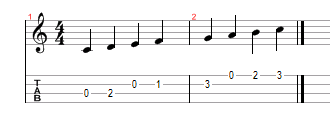
Whether the stems of the notes go up or down doesn’t make any difference at all.

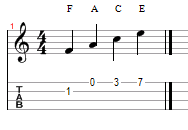
The notes that fall in between the lines spell “FACE” from bottom to top.
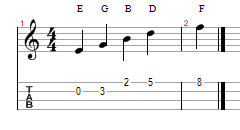
The notes on the lines spell “EGBDF”. If you’re not familiar with the word ‘egbdf’, there are plenty of mnemonics to remember it such as Every Good Boy Deserves Football (or any other f-word you think a boy might enjoy).
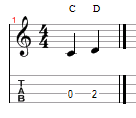
On the uke, there are two notes that fall below this: C and D. The D hangs underneath the stave, and the C is on a line drawn underneath it.
Like tab, you read music left to right with notes that are vertical are played at the same time e.g.
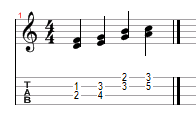
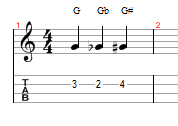
You might have noticed that none of the notes we’ve discussed are sharp or flat. Sharps and flats are indicated with a sharp (#) or flat (b) before the note like this:
When it comes to the ukulele, standard notation has some serious shortcomings. For one, it can’t tell you which string you’re supposed to be playing a note on (a big drawback since the uke has so many options for playing the same notes). For instance, Example 1 could equally be played like this:
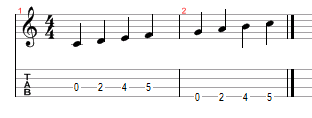
Or any of a whole array of other ways.

25 Comments

  1. Brad July 23rd, 2008 10:16 pm

    I suppose it depends on your background and perspective. I learned to read music as a kid and have only been playing uke for about a year so I find that tab is more difficult to read and that using the written notes helps me with the rhythm as well as learning where individual notes are on the fretboard. Learning that the open G on the 4th string is the same (on a high G uke) as the 3rd fret of the 2nd string gives an option on how to play a melody, for example. Once you learn to read written music, you have an amazing source for finding music to play, such as old sheet music.
    Thanks providing the introduction.

  2. T July 23rd, 2008 10:49 pm

    Thanks very much for this.

  3. amber July 24th, 2008 7:47 am

    Every Good Boy Does Fine

    That’s how I was taught.

  4. Isaac July 24th, 2008 8:56 am

    I did up to grade 5 theory of music and used to play the piano- but would hate reading uke music from just standard notation. I like when they have both standard and tab.

  5. zymeck July 24th, 2008 9:24 am

    we were taught “Every Good Boy Deserves Football”

    although as we werent good boys we replaced Football with something else beginning with ‘F’

    :)

  6. zymeck July 24th, 2008 9:25 am

    damn,

    i really should read these posts before I comment :(

  7. Howlin' Hobbit July 24th, 2008 3:51 pm

    Re: the sharps and flats. Accidentals are indicated by the sharp or flat sign before them. Any sharps or flats that occur normally in a given key are given in the key signature and you’re just supposed to remember that the given note(s) must be played sharp or flat as you play it.

    That’s what used to throw me for a dang loop when I was in school band tootling on the clarinet.

  8. Woodshed July 24th, 2008 10:09 pm

    Brad: Thanks for the alternative perspective.

    T: You’re welcome.

    Amber: I always heard ‘Nice guys finish last’ which seems more accurate.

    Issac: Yeah, I think that’s probably the best layout.

    Andy: Great minds and all that.

    Hobbit: Thanks for that.

  9. Gotago August 14th, 2008 2:51 am

    where can i find saxophone music?? any good websites

  10. Howlin' Hobbit August 14th, 2008 2:57 am

    Try saxfiends.com. :-p

  11. jon August 23rd, 2008 5:32 pm

    Can anyone recommend a uku sheet music book for classic rock such as the beatles or dylan?
    thanks

  12. Woodshed August 24th, 2008 7:13 pm

    Jon: I think Jim Beloff’s 60s Uke In might be what you’re looking for.

  13. jon August 31st, 2008 4:57 pm

    Thanks to Woodshed for the tip. I am going to buy it.

  14. Woodshed August 31st, 2008 7:16 pm

    Hope you like it, Jon.

  15. David Barnes September 3rd, 2008 3:55 pm

    Hey woodshed, these ukulele 101 lessons were the highlight of my ukehunt week. And they were just getting beyond where I was comfortable when they stopped coming. Any chance of resurrecting them, please?

  16. Woodshed September 3rd, 2008 7:09 pm

    David: The ukulele 101 stuff is/was a beginners’ series. The problem with beginners’ series is that they pretty soon end up being intermediates’ series. What else would you want in the series?

  17. TAMSIN December 26th, 2008 10:41 am

    I AM 11 YEARS OLD i am really great with pianos/keyboards but im stuck with the f.a.c.e and egbdf i have no clue were they go could you please help me

  18. AndreaC December 26th, 2008 10:16 pm

    TAMSIN… FACE are the notes in between the lines of the staff (in the treble clef), and EGBDF are the notes that are ON the lines. They go from bottom to top.

    The second diagram in the post on this page shows what the FACE notes look like. The third diagram shows what the EGBDF notes look like.

    So examples: if a note is in the space between the bottom two lines, it’s F, and if a note is right on the middle line it’s B.

  19. Woodshed December 27th, 2008 9:50 am

    Andrea: Thanks very much for the explanation.

  20. H June 27th, 2009 2:59 am

    Does anyone know of a good book that will teach me where the notes are on the fret board and what I am playing as read in standard notation? I’m very visual so tablature doesn’t really help when I can’t see what I am playing on a staff.

    I’ve been learning fiddle and the book were using is a lot like what is used in grade school band class. The book is the American Fiddle Method and it teaches you where the notes are on the fingerboard and you read this in standard notation. Very minimal use of any kind of tablature, just introducing where the notes are initially above the staff with a number, and slowly builds to knew fingerings etc. I know the fingerboard of a fiddle way better then my uke, so well I can already play without looking, and I’ve been playing fiddle for 4 months now… It’s very frustrating when I’ve been trying to get uke down for 2 years and the fret board is still a big puzzle to me.

  21. Sandy February 15th, 2010 4:27 pm

    Like the Hobbit, I too have been tootin’ on my clarient for 6 years, so I understand how to read the notes, but I DONT understand the numbers on the bottom. I’m working on the Happy Days Theme Song chord sheet on this website, and I just can’t seem to understand the solo, or anything in this format. >.< Peas help!

  22. Howlin' Hobbit February 15th, 2010 4:46 pm

    Sandy,

    Tab basically tells you which fret on which string you press in order to make the note above it (if it’s the staff & tab display). Plain tab doesn’t have the notes but it’s the same thing, “Just press here”.

    Woodshed did a pretty fine job of explaining tab and linked to it up in the original post. Check it out.

  23. Woodshed February 15th, 2010 9:45 pm

    Sandy: Here’s the tab reading guide that Hobbit mentioned.

  24. Phil February 25th, 2010 3:52 pm

    Reading music is not any harder than tab, plus it has its benefits over tab. It’s about as hard as Third Grade Math.

    Most tab just tells you where to fret the string but some adds rhythm flags) . The problem with tab is that you must KNOW how the song goes before you play. With notation, you can know mostly how a song goes and fill in the blanks with the notation.

    The ($5.50) Alfred handy guide, (11 x 4 inches) How to Play the Ukulele has a fretboard map with all the notes listed for each fret. on the back cover.

    The 45-page booklet show music notation on the staff with each note market in white type on the notehead.

    This gives you an E note on the first line of staff along with the notehead with an E ikn white type.

    The re-entrant tuned ( high G) uke only has about an octave (a few go above the 12th fret),

    This means the note range goes from Middle C to high A (if your uke stops at the 12th fret).

    This means that any old songbook within that range can be played melody style on your uke. You can also plink out the melody line of Jumpin Jim’s books. (If you play the notes, you get double your money’s worth.

    It also means that once you understand this basic idea, you no longer have to depend on books written expressly for the uke.

    Further, you can take better advantage of fake books. Fake books look like the style used by Jumpin JIm — a simplified sheet music with a melody line (one note at a time) , a chord listed above the music staff: C, C7, G, Am without chord boxes. You can buy pop fake books, Beatle fake books, blues, country, Broadway.

    With a little bit of effort, you can not only play the chords, but the melody of a song from a fake book.

    The key signature shows what flats or sharpts go with a song. The tricky part is that Bb in the key signature stays in effect for the entire song. If you have trouble remembering that Bb, get your pencil out and put a flat sign next to each Bb — until it becomes automatic.

    Now if you have a low G uke, your lowest note in the G below middle C which will give you a slightly more range.

    Hope this helps

  25. Woodshed February 25th, 2010 6:37 pm

    Phil: Thanks very much for all the info. Useful stuff.

Got something to say?