Two videos you only need to watch half of this week. Lou Barlow (off of Sebadoh) does two songs but the most entertaining part of the second is watching the people stood out in a rain storm. In the Polytecnik video the song stops and the visuals keep going. I assume it’s a video screw up but you can never tell with these arty types.
Also this week UOGB’s Richie lays out, She and Him and the only Nirvana ukulele cover I’ve enjoyed.
It’s interesting to see more US companies bringing out banjo-ukes recently – particularly the mix between the smaller style of banjolele which I associate with the US (like this one Aaron Keim is playing) and the larger type played by English ukers like George Formby and Mr B (I have no interest in banjoleles so these terms are completely wrong). Lanikai have gone with the English style for their LBU-C. The Mainland banjolele is a minimal one. And Morgan Monroe have a mixture of both. I’m a bit surprised Lanikai have gone with the English-style. The influence of Mr B? Or am I missing something?
Last week’s highly ornate Blueberry ukulele divided opinion in the comments. According to shumanyo, “Blueberry ukes look very nice but they are way too braced and damn heavy so the uke simply doesn’t vibrates resulting in a uke that is not and not ‘’singing”much. The soundborad is way too stiff.” Which isn’t a surprise. But we all know it’s how pretty the outside that matters, so here’s another one – this time featuring a scantily clad lady.
Hester Goodman from the Ukulele Orchestra of Great Britain has a solo record coming out You Could At Least Smile. You can on UOGBfans. And here’s the first TV interview and performance from a very fresh faced version of the Ukes back in 1988.
Missing uke in Auckland: Friend of the blog, Zoway was supposed to be getting a Mango Fluke for her eighteenth birthday. Her Dad was bringing one over from the big island, got as far as Auckland airport and lost it. It’s a long shot but if anyone knows its whereabouts shoot me a message.
Live ‘Ukulele has an interesting post about tabs vs. working out by ear. While I think there’s a lot to be gained from using other people’s tabs, you certainly do get to know a song better and come up with something more personal if you work out your own version.
Why was I using my Sceptre in this video? The trickiest part of this song is the clapping: keeping the rhythm is tricky but dealing with the constant danger of your uke dropping to the floor is the big worry. So don’t use your favourite uke. Of course, you could save yourself the bother by doing chnks instead of claps. But where’s the fun in that.
Twiddly Bits
In place of a set of claps, I did a couple of fills. They were improvised using the C major pentatonic. Here’s the first twiddle I did:
I expect a fair few of you have seen Mighty Uke already. They’ve been touring the film around and it’s been shown at a number of festivals. As a matter of fact, they are planning a tour of the UK later this year so if you’d like to host them at your uke group send them a message here.
For those of you not familiar with it. Mighty Uke is a documentary charting the history of the ukulele and the current uke boom. It has interviews with Jake, Shimabukuro, James Hill, John King, Dent May among many others.
The DVD is released this month and Tony Coleman (half of the team behind it with Margaret Meagher) was kind enough to send me a copy for review.
The Good Stuff
An enjoyable watch: It’s a very pleasant way to spend 79 minutes. There’s plenty of good music, lovely archive footage, and lots of ukulele friends (and one enemy). By the end of the film I was dying to pick up my ukulele and get playing. Definitely well worth a watch for anyone interested in the ukulele.
The Shorts: Easily my favourite part of the DVD. There are ten little segments of between one and a half and ten minutes each focusing one group or individual (and one on Martin ukuleles). Outside of the film – where people have to fit into the narrative – you get a much clearer sense of individual personalities and motivations. So Taimane loves being centre of attention, Steven Sproat sits alone under a tree wanting to show the bigger boys that the ukulele could be as cool as Nazareth and Pink Floyd, The Langley Ukulele Ensemble are pulled from their beds and marched single file at great speed whilst spraying notes everywhere.
Quoteables: There are lots of little nuggets in the film (many of which I intend to steal). My favourite comes from Aaron Keim: “No one ever failed the audition for the ukulele band then quit.”
The Not So Good Stuff
The Inter-what?: It’s a little unfair to criticize films like this for what they leave out. It can’t just be a long list of everyone who has ever played the ukulele. It’s an independent film so there’s not enough money for IZ’s music and it’s quite focused on North America. And some people just don’t want to take part (the UOGB declined). The fact that it isn’t comprehensive doesn’t diminish it at all. Except…
How you could possibly cover the current ukulele boom without a single mention of the internet? I realise I’m completely biased in this respect, but to my eyes the internet has played such a huge part in the spread of the ukulele that it’s impossible to ignore. If you think I’m too deep into this to recognise the truth that no one cares about the net, let me know in the comments.
One big happy family: The film’s central theme is that the ukulele brings people together and players love strumming in a big circle and all ukulele players are happy and well adjusted and if everyone played the ukulele there wouldn’t be any war and… OH MY GOD I WANT TO PUNCH SOMEONE IN THE FACE!
I’m a maladjusted, loner, bell-end and that doesn’t stop me playing the ukulele. Sometimes all this group-hugging makes me want to go back to playing the guitar where it’s acceptable, even encouraged, to roll with the badass-outsider/reclusive-genius image.
Overall
Mighty Uke is a very enjoyable film. If it’s rolling through your town, definitely go see it.
As for shelling out $30 for the DVD (or $35 for international orders), I’m a little more circumspect. It didn’t inspire me enough to warrant repeat viewings. But if you have uke-ignorant family and friends that you want to lay some knowledge on, get a copy and show it round. There’s no better way to introduce non-ukers to the ukulele world than watching Mighty Uke. And by the end they’ll want to play themselves.
The Mighty Uke is released on DVD on 28th September. You can pre-order your copy here. The Mighty Uke team are planning a tour of the UK later this year so if you’d like to host them at your uke group shoot them a message here.
I’ve resisted calls for posts on recent YouTube phenomenons Double Rainbow and Bed Intruder (because A Glorious Dawn is the pinnacle of autotune). But I had to do a post on Cee Lo Green’s new song. Partly because it’s packed with expletives (it’s not even the first time I’ve put up a song called Fuck You). But mostly because it’s a cracking tune and it’s finally given blokes their own I Will Survive-type break-up song.
Suggested Strumming
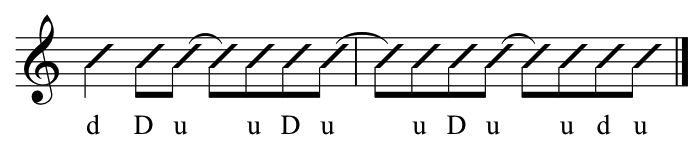
Here’s the strumming pattern I like to use for most of the song:
The only exception is the middle section where I just use one strum for most of the chords. At this stage, I should admit I’m not 100% sure of the chords in that section.
The guitar part works pretty well on the uke. Use these inversions of the chords:
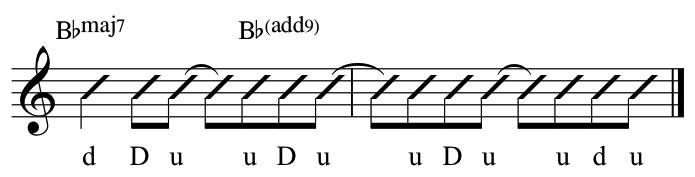
And this strumming pattern:
Twiddly Bits
If you want to ape the bass/piano run-ups, try this:
It my not look like it, but I do put some thought into the order of videos in the UkeTube posts. Usually I’ll switch the around a bit and come up with something that I feel flows well fairly quickly. But this week I couldn’t come up with anything I was satisfied with. I’ve even taken a few videos out to get things to work better. I’m still not happy, so watch them in any order you please.
The selection includes catchy tunes from April Smith and Bella Hemming; something more challenging from The Acorn and The Penguin Cafe Orchestra; and some UFO spotting from the Asylum Street Spankers (who I should include on this site far more often).
This week I’ve spent far too long surfing through demos of effects pedals – the stranger and filthier the better. Death By Audio have a range of interesting pedals. My favourite being the Robot (demo here). But I think my favourite at the moment is the WMD Geiger Counter (demo here).
On a more traditional note, this week’s uke-I-want-most is this Joel Ekhaus Stradelele.
An interesting pair of Regals: a very handsome P’MICo and a Wendall Hall TeeViola.
Some incredibly fancy wood work on this Blueberry tenor.
Two podcasts dedicated to the ukulele: WNYC talk to Tony ‘Mighty Uke’ Coleman and have a cracking session from Buke and Gass (along with the interesting info that Aron from the band used to design instruments for the Blue Man Group). The Shuffle chat to Ty Olopai and play a bunch of uke tracks (listen to Show #10-34 Hour 2 – August 21, 2010).
Jim D’Ville has a thought-provoking post about active listening. I’m definitely guilty of spending too much time listening to the voice(s) inside my head.
In the comments: Ukulelia‘s Gary has a few theories about the ukulele including, “the uke may be an especially good instrument for online videos because it’s easy to fit within the shot of a web cam.”
It’s refreshing to see one of the big stars picking up a ukulele and not doing a bit of gentle strumming but really ripping the shit out of it. And it’s even more satisfying when it’s someone as talented as Kaki King.
The last time we heard this tune it was a loose, instrumental jam. Since then it’s been tightened up, given lyrics and had the space-trumpet sorted out. Now it’s really rocking and is the lead single from Kaki King’s new one.
The good news: the fretting-hand part is dead easy. For half the song you’re just using it to prop up the neck. The bad news: everything else is a pain in the arse.
The Tuning
It’s in a very strange tuning:
E F# C# F#
Yes, that’s the tuning for a ukulele. Here are the notes.
All those are tuned down. The C-string is very low – making it sound rubbery and very hard to keep in tune. Kaki has troubles with this herself so don’t feel bad if you do.
The Time Signature
I’m not entirely sure, but the main riff makes most sense to me in 7/8 time (1, 2, 3, 4, 5, 6… 7, 8). I find the easiest way to count it is: 1, 2, 3, 4, 1, 2, 3.
The song switches into 2/4 time (I think) at bars 10, 24 and 45.
The Picking
This is the toughest part of the tune. The pattern is a little tricky but the challenge is keeping it up. The picking is relentless and I feel sore by the time I get to the strumming section (which comes as a huge relief).
The main riff is picked (with old string names):
Thumb = g-string
Index = C-string
Middle = E-string
Ring = A-string
And in the 2/4 sections:
Thumb = C-string
Index = E-string
Middle = A-string