The blog officially became two years old yesterday, so it’s time for my annual self-indulgent, navel-gazing, rambling post. It’s very long, quite personal, occasionally pretentious and I won’t hate you for skipping it.
Last Year’s Goals
In last year’s post I set a few goals for the blog that I thought were impossible. So let’s see how I did.
1) Stay number 1 on the Top 50 Ukulele Sites
Result: Success.
I’m still pretty firmly in the top spot.
2) Number one on Google.com for:
It should be pointed out the results vary according to where you are. So what I see may be different to what you see. In particular, Google.co.uk seems to hate me.
a) Ukulele Tabs
Result: Success
I’ve been number one for a while and don’t seem to move from there. When I said I thought this was impossible, I lied.
b) Ukulele Chords
Result: Failure
This is the one I’ve put most work into. A few months ago I was around position 5 and really worked at it. But at the moment I’m hovering around between 2 and 3. With the benefit of hindsight, it was stupid of me to put the chords and tabs on one page. I also lied about thinking this one was impossible. I still think it’s possible.
c) Ukulele
Result: Failure
I seem to spend most of my time at position 2. But occasionally that Ukulele Gently Weeps guy goes ahead of me.
I told the truth when I said I thought this one was impossible. Wikipedia is next to impossible to beat. Even Google CEO Eric Schmidt can’t beat Wikipedia for his own name in his own search engine. So I didn’t stand much chance.
3) 1 Million Visits
Result: Success.
I’ve had over one and a quarter million hits in the last year with over six and a quarter million page views. When I think about those sort of numbers my head starts to hurt.
4) 1,500 Subscribers
Result: Success.
1,000 people subscribe by email, 700ish by RSS feed and 200 and some by Twitter.
This one scares me even more than the last one. There are 2,000 people out there who want to be informed of what I have to say every single day. What are you people? Stalkers?
Overall
There might be a few near misses in there, but I’m delighted the way the last year has gone. I owe a huge thanks to everyone who has commented, talk about the site, pruf red my stuff, been interviewed, offered their advice, subscribed and said nice things to and about me.
I owe an even huger thanks to my family and Jenny who’ve been massively supportive since day one. Unbelievably, when announced that I’d quit my job in accounts and had decided to write about the ukulele instead none of those people tried to slap some sense into me. Which is just one reason why they’re my favourite people in the world.
Next Year’s Goals
This year’s goals are going to be very different to last year’s.
For one thing, the site is plenty big enough now. If it never gets any bigger than it is now, that’s fine with me.
For another, those goals were boring. They were very SMART. I think the SMART system is a great set of training wheels for people who, like me, have had all sense of ambition beaten out of them by education and work.
But since reading Chris Guillebeau’s Guide to World Domination, I’ve been thinking I should set my goals a little more on the way out side.
So my goal is to ensure that:
Everyone in the world who wants to play a musical instrument does play a musical instrument.
That goal isn’t specific, measurable, attainable, realistic or timely. I don’t have the first clue how to go about making it so. I’m not entirely sure what it even means. It’s vomit worthy in its ‘I’d like to teach the world to sing’ sentimentality. In short, it’s the stupidest goal ever set. But there you have it.
Almost all the TED Talks get me thinking. But this one by Larry Lessig particularly got my attention. He talks about Sousa’s prediction that ‘talking machines’ would stop people making their own music and become consumers of music. He was absolutely right about that (but less right about man de-evolving vocal cords). Lessig points out that the internet is reviving the amateur culture; people are making music (and videos, art, poetry, software, books and even businesses – if an amateur business isn’t a contradiction in terms) off their own backs. He goes on to talk about mash-ups and copyright law. But it’s equally obvious in the number of people recording ukulele videos and putting them up on YouTube, recording music and releasing it on the net or getting together to form uke groups. I think it would be a shame for people to miss out on it because making something is more fun and more rewarding than using something.
From the start, one of my – unstated for being too ridiculous – aims for the blog was to make sure everyone who started playing the ukulele didn’t stop. And this goal is widening it out a bit. I think one of the main reasons people want to make music but don’t is they don’t think they have any musical ability (often because they’ve been told that – often, unforgivably, by teachers). Which makes the ukulele the perfect place to start. No matter what the arguments over how easy it is to play, no-one is intimidated by the ukulele.
It’s also one of the reasons I was keen to do something for Ukuleles for Peace. There are plenty of other good reasons to support it as well. So if you haven’t bought that ebook yet – do it.
If you have any idea how to set about achieving it, do let me know. (Just don’t mention the word ‘school’.)
Coming Up (Or Not)
I get a lot of suggestions – many of them ending with the words, “off and die.” But some of them are very good. I even have my own ideas some times. Here are a selection of things that you can expect to see, some you might see, and some you won’t.
Will Happen
– Various people have told me I should be doing Uke Hunt t-shirts and they were absolutely right. But I didn’t want to do a boring shirt with just a logo on. So I searched and eventually found the right person to design them. The first set of shirts are being designed by Art Grootfontein. And here’s a glimpse at the first one and here’s the second.
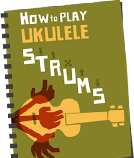
– How to Play Ukulele Strums. By far the most requested ebook. It has been in the works for a long time. I’m finding it really difficult to write. Perhaps because so much of the stuff out there about strums misses the point entirely or is just plain rubbish. But it is slowly coming together and I think it will be really useful once it’s finished.
Might Happen
Feel free to voice your opinions on whether you want these.
– Captain Obvious Week. I get buckets of requests for songs like I’m Yours that have been done so many times on the ukulele they make me want to stab my ears with an icepick. Usually I just reply that I’m Yours would never work on the ukulele. But that just ends up in me being called a douche by the semi-literate. So I’m tempted to get this sort of thing out the way. Except I think my so-hip-it-hurts regular readers will – quite rightly – leave never to return.
– More videos.
– Some sort of membership area of the site that would be closed off to passers-by.
– Uke Hunt net-label. I like the idea and, with the record industry in such rude health, how could it fail? But orgainising things that involve more people than just me isn’t my strong suit. (This one probably belongs in the ‘Will Never Happen’ section).
– Retire the Fingerpicking mini-course.
– Regular Twittering. During my break recently my blog muscles started to atrophy. So I decided to start Twittering properly. It doesn’t appeal to me anywhere near as much as blogging. There’s not much long term benefit to it. After a few hours no one is ever going to see your tweet ever again. But it does have its uses.
Will Never Happen
– Uke Hunt festival. Suggested by James Hill and seconded by Jimmy.
I don’t have my shit together anywhere near enough to pull something like this off. My organisational skills are stretched to the full making sure I wear enough clothes to keep myself out of jail when I venture outside.
– Bosko and Honey style world trip of ukulele players. Suggested by Ukulelezo.
It worked for Bosko and Honey because they’re friendly, affable, talented and generally adorable. I, on the other hand, am a surly, anti-social douche. But the idea does appeal to me in theory. And if I could come up with a way to make it more interesting than just a poor-man’s Ukulele Safari it might move itself into the maybe category.