Another song for the ‘bands you wouldn’t expect to hear playing the ukulele’ section. This tune is from The Shortwave Set’s ‘Victorian Funk’ album The Debt Collection. Of course, there weren’t any ukuleles in England during the Victorian era, but that’s just nit-picking.
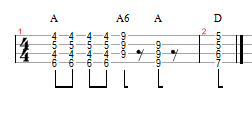
The ukulele part is quite traditional (and in D tuning) but cut up and twisted around. The basis of it is this:
This week, I thought I’d go over the easiest scale around. It only has five notes in – as the ancient Romans amongst you will have already worked out. It’s also used almost exclusively in blues and rock music.
C Minor Pentatonic
The C minor pentatonic looks like this on the fretboard:
The end lick in that is easy to play and very effective. Here’s the tab of it:
D Minor Pentatonic
As with the major scale, the minor pentatonic pattern can be moved up the neck to fit with whichever key you’re playing in. Find the root note on the C string and start the pattern from there. For example, if you’re playing in the key of D minor, start the pattern on the second fret so it looks like this on the fretboard:
And this in tab:
F Minor Pentatonic
Similarly for F minor, you start on the fifth fret of the C string like this:
And this:
If you can get this scale under your fingers, next week’s scale – the blues scale – will be a doddle.
If you want to learn more stuff you can do with this scale, check out my Blues Ukulele ebook.
A while back I was knocked out by a video of Priscilla Ahn playing a ukulele song. But there wasn’t any indication of what it’s called. I begged for more information but didn’t get any. Luckily for all of us, the song has cropped up on her new album A Good Day and I couldn’t resist working it out.
She’s tuned down half a step for the studio and the live versions (but I’ve kept the chord names in C tuning to save confusion). The song uses some slightly unusual chords (C6, G9, F6). There are also two versions of the C6 chord (one with all the strings open and one in the third position). She seems to use these interchangeably on the live versions, but I’ve tabbed out the version on the record.
There’s an interesting move on the ‘Bubbles…’ part where she cycles through the diminished chords. All these chords are the same shape yet have notes in them (A, Eb, F# and C). Check if you don’t believe me (and have absolutely nothing going on in your life).
After that there’s a little single note run which goes something like this:
For the final run part of the song, she stops strumming and starts picking. The picking pattern goes like this:
Quick reminder: You’ve got until midnight on Sunday to review your ukulele and win a Kala pineapple.
Here’s how it goes sometimes: I hear some ukulele music I really like, I ask the person if they mind answering a few questions, they say ‘go ahead’, I send them some questions, they realise the questions are idiotic and offensive and I never hear from them again. I can’t offer much in the way of facts with these two, but you should definitely check out the music.
Entertainment for the Braindead’s Hypersomnia is a quite brilliant album of drowsy, spaced out, acoustic songs. You can download it all for free here and buy the CD here.
Because of my anti-football prejudice, I’d never considered tabbing this out before. With the final of Euro 2008 today (that’s soccerball to you North Americans), I thought it would be fitting and, blow me down, it could have been written for the ukulele. It also makes for a great football tune medley when it’s followed by Stars and Stripes Forever (AKA ‘Ere We Go).
Most of it is fairly simple strumming. The trickiest bits are the places where you switch from strumming to fingerpicking and the jump up to the third fret. But it’s well worth practicing (if you’re British at least).
There have been three Jupiter Creek ukuleles crop up on eBay this week. The baritone has gone already, but you still have a shot at a concert and a tenor. There’s also a soprano for sale on eBay France.
It’s not often you see RISAs on eBay, but there’s a Meltocaster on there right now. It’s a guitarlele rather than a uke, though. And I still can’t quite come to terms with that shape.
The RISA isn’t the only strangely shaped ukulele on eBay at the moment. There are ukes shaped like a biscuit tin (strangely inelegant for a Lyon and Healy ukulele), a teardrop (I’m pretty sure that’s also a Lyon and Healy: a Venetian ukulele) and, best of all, an aeroplane.
It’s not often that there’s a ukulele I’m lusting after more than one shaped like an aeroplane, but this week that’s the case. MGM has a James Hill Signature JSM-2 ukulele up for sale right now (made by G String). I can always kid myself that if I had one, I’d play just like James Hill and no one can prove otherwise.
There’s a banjo ukulele collector who’s selling off his collection on eBay UK. There’s a Gibson UB3, a Maybell, a Bruno (made by Harmony ukuleles and an Avalon. All look very well cared for.
“lately all I do is talk about my ukulele, but I honestly love it more than life. sometimes I just hold it to my heart and sigh because I love it so. I think maybe I’ll be a good mother if I love an instrument this much?” Quote from probably the coolest girl on the planet.
YouTube’s little ukulele video feature made me reassess this song. I’d skipped over it fairly quickly the first time round – there are a lot of ukulele videos to watch – but I shouldn’t have, it’s a damn fine song (no such change of heart over Where Your Scar Is though) and it’s already inspired its own ukulele tribute parody.
For this song Lauren and Lena are tuned to DGBE: baritone/guitar tuning – five frets lower than the standard ukulele tuning. Other than that, the chords are pretty easy. Much easier than they make them look.
When I did my ukulele scalesposts there were a few people who didn’t have a clue what it was all about. So, I thought I’d go back to basics and cover it from there.
The most common scale in all music is the major scale. You’ll hear it all over the place (pretty much every nursery rhyme, Christmas carol and national anthem uses it) and it’s the basis of all chords.
The major scale creates a particular pattern on the ukulele. This pattern can be moved up and down the neck depending on which key you play in.
C Major Scale
The most important note to concentrate on is the root note – the first one played and the last one played. For example, The C major scale starts on the open C string and ends on the A string, third fret. The pattern looks like this on the fretboard:
The tab looks like this:
And sounds like this:
There are lots of ways you can use the major scale. One is for improvising a solo. In the following snippet, I’m improvising a little melody with the chords C, F and G and using only notes in the major scale pattern.
D Major Scale
For the D major scale, you use exactly the same pattern but start on a D note (C string second fret) and end on a D note (A string, fifth fret). Giving you this:
F Major Scale
Moving that pattern up and down the fretboard will give you a major scale wherever you use it. Whichever key you want to play the major scale in, find that note on the C string and start the pattern from there.
For example, to get the F major scale, you start the scale pattern on the fifth fret of the c string which gives you this pattern: