Sanford and Son never made it over here so I’m wasn’t very familiar with the theme tune before I started working on my version. Which might explain whey I go rogue at a few points in the arrangement. Particularly in the middle section where I’m improvising between the main theme (although the main theme itself isn’t very strong in this section).
There are a couple of techniques you’ll need to use quite extensively in the tune: right-hand muting (resting the underside of your hand on the strings just in front of the bridge) and strum blocking. Strum-blocking is something I’ll have to write a full post about. Briefly, it involves playing single notes by strumming and blocking the strings you’re not playing by muting with left-hand fingers (or right-hand fingers if you’re left handed). The advantages of this way of playing is that it gives you more attack and makes it easier to switch between chords and single notes.
If you’re anything like me you’ll often hear, “Wow, I didn’t know they could be that small. Does it even work?” And I expect I’ll hear it even more often now I’ve bought a Kala Pocket Uke.
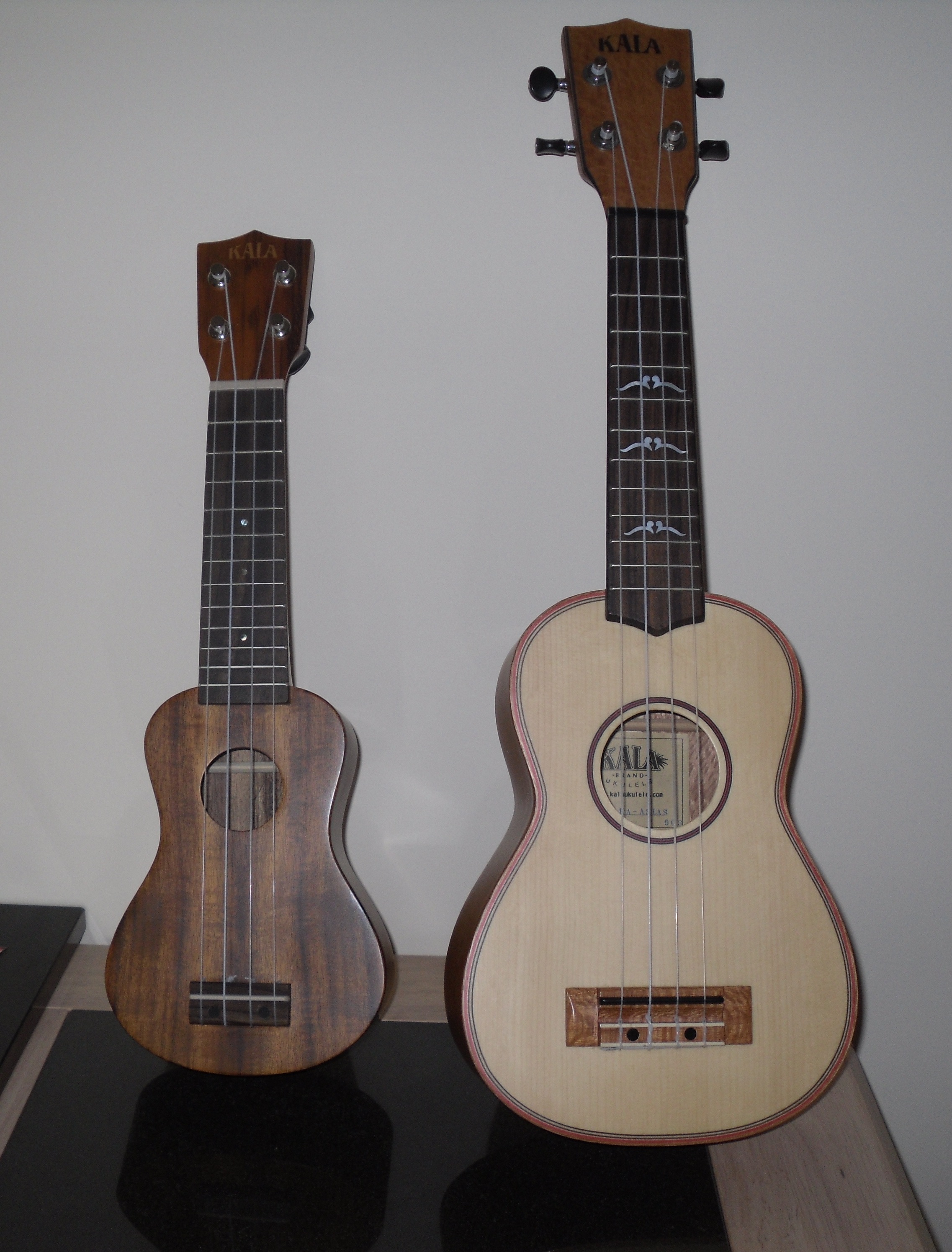
The Pocket Ukulele is Kala’s sopranino size ukulele (although they do the smart thing market-wise and avoid the term ‘sopranino’). And it’s certainly tiny. Here’s a photo of it next to a standard soprano.
It has obvious gimmick appeal. But with a significant price tag (MGM currently has them for $279) they have to go beyond that to make them a worthwhile purchase.
Novelty Value: The big appeal of it certainly is the cute-factor. And there’s a lot of fun to be had playing it. I couldn’t resist pulling out some of the old music hall tricks on it.
Strumming: With some fast paced strumming it sounds great. ‘Primitive’ is the word I’d use (and I certainly don’t mean that in a bad way). And it’s louder than I would have expected.
Transportability: It fits comfortably length-ways in a laptop bag. The gigbag is very sturdy too (although significantly bigger than it needs to be).
Smell: Strong, almost burnt smell to it. I like it. (I don’t know how this became an official category for judgment, but it is.)
The Not So Good Stuff
Playability: Even with my tiny lady-hands it’s difficult to play. Fretting accurately is very difficult (even Bartt has trouble keeping it in tune). The intonation test is a bit misleading really. I had to fret incredibly carefully to make the test fair. In real playing you won’t be able to fret accurately further up the neck.
Tone: Compared to a standard solid wood ukulele, there’s not much tone there. Unless you’re giving it some welly, it’s very lacking. And I’d avoid any single-note playing on it.
Friction Tuners: They didn’t have any choice but to use friction tuners on here. They’re decent enough but they’re always going to be more of a pain to work with than geared tuners.
Overall
The Kala Pocket Ukulele is a soprano ukulele turned up to 11. All the things you love about the soprano are amplified. And so are the annoying things about them.
There’s certainly a place for it. I think it’s best use would be adding an extra tonal layer in a group. The sound is distinct from other ukuleles and it does what it’s good at very well. But don’t buy it as an all-purpose ukulele.
Here’s the version that makes the ukulele explode.
And it really is a B flat that does it. Interestingly, B flat seems to be the note and key of choice for comedy. I seem to remember George saying, “We should have done it in B flat,” after the UOGB’s song on Skins.
I almost broken my golden rule this week by posting Taimane’s cover of Eleanor Rigby. But in the end she got elbowed out by some less expected covers of tunes by NWA, Iron Maiden and Rodrigo y Gabriela.
Also up is a performance by Heather Smith at the Chicago Ukulele Cabaret. You can read a rundown of the event here (thanks to Anne for alerting me to that) but the main reason to read it is to see Ted from the original Ukulele Cabaret getting uppity about them stealing the name in the comments.
A couple of interesting ukes from Mike Chock: mango and papaya. How do you feel about the increasing number of weird ukulele shapes? Every time I see one I squee a little but it quickly becomes a bit of a novelty. The guitar-shape of the ukulele is more an accident of history than anything but it is classy.
If you missed the first of Bossa’s Ukulele! Radio Shows you missed some killer tracks, a chat with Armelle and an awkward interview with the world’s handsomest ukulele blogger. Make sure you don’t miss the next one on Wednesday 26th May, 7-8pm UK time.
Gary San Angel, producer of The KoAloha Story and he’s got a new project he wants you to be involved with:
The project is called, “My KoAloha Story”. The concept is simple. I’ll be sending a HD camera out to trusted individuals around the country and the world. Individuals would film themselves telling a story, playing a song and perhaps giving their own testimonial about their own KoAloha story. KoAloha as you know is a unique company and many KoAloha uke players have had very inspired and moving experiences in relation to their instrument.
Boulder Acoustic Society are raising funds to release their new album. I’ve signed myself up for one of their ukulele player packages. If you really want to splash the cash, you can get yourself a one-off Mya Moe Ukulele.
I was quite impressed by Billy Corgan’s ukulele playing. He certainly seems to take it more seriously than most of the guitarists who jump on the bandwagon and make a hash of it. For a start, he isn’t using a pick. And he throws in some classic ukulele stuff like diminished chords and a triplet strum. It’s enough to forgive him for playing a Fender and braiding Jessica Simpson’s prayers.
The reason, as can be heard in the full intro to the song, is that he learnt ukulele from a Hawaiian friend. Nice work, Hawaiian Corgan-buddy!
Suggested Strumming
The strumming skips around quite a bit so I’m not going to go through all of it. This is the main one:
d – x u d u x –
Do that for each chord in the verse until the end D7 – G7. Here you get a typical Hawaiian turnaround. Here the C chord doesn’t quite fill the bar. Instead of the final ‘-‘ on the C chord you do an up strum on the D7 chord. So you strum this:
u d u –
And the same for the G7 chord.
In the chorus it’s all triplet strums on the C – Fm moves.